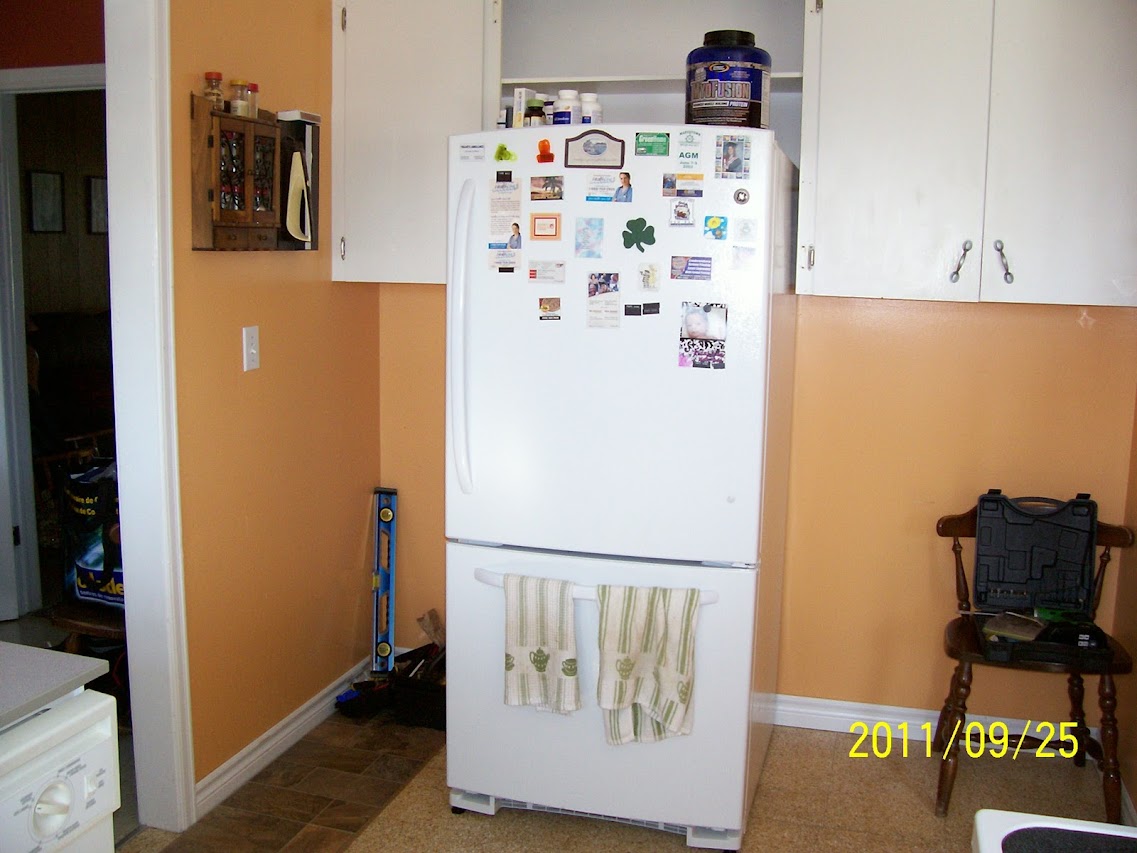
With the new refrigerator in its new location (see Phase 1), the plan was to get a kit so that the portable dishwasher would not have to be moved to the sink for use. The plumbing would not be too difficult, and it would be a great convenience.
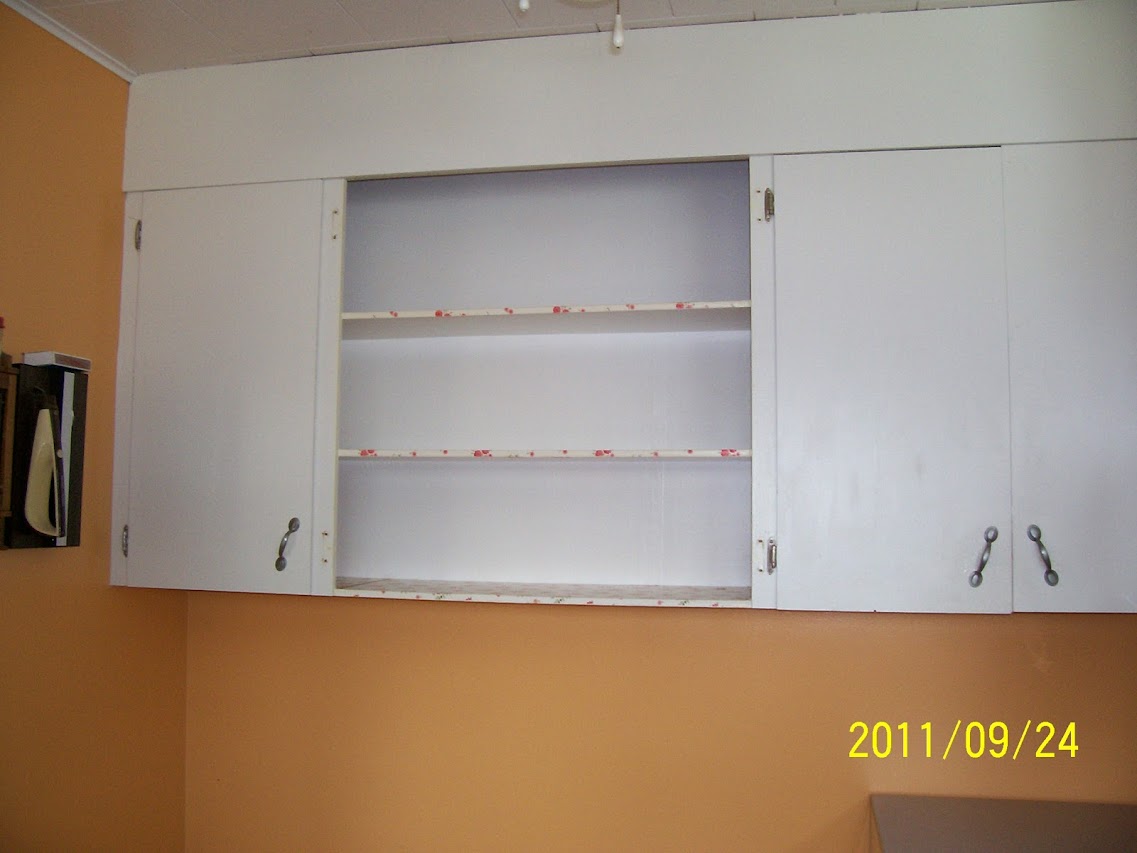
However, as I was sizing this up, I realized that the 45 year old cupboards that I had repaired and painted just a couple years previous were starting to fall apart again. Also, with the cushion floor having been ruined when the new fridge arrived, we were back to the old, ugly and broken tiles. Some new flooring was required.
It was decided to order some cabinets, and update that side of the kitchen. After consulting with the Kim at the Notre Dame Castle store, we came up with a design, and settled on the styles for the doors and flooring. They would be ready in a few weeks.
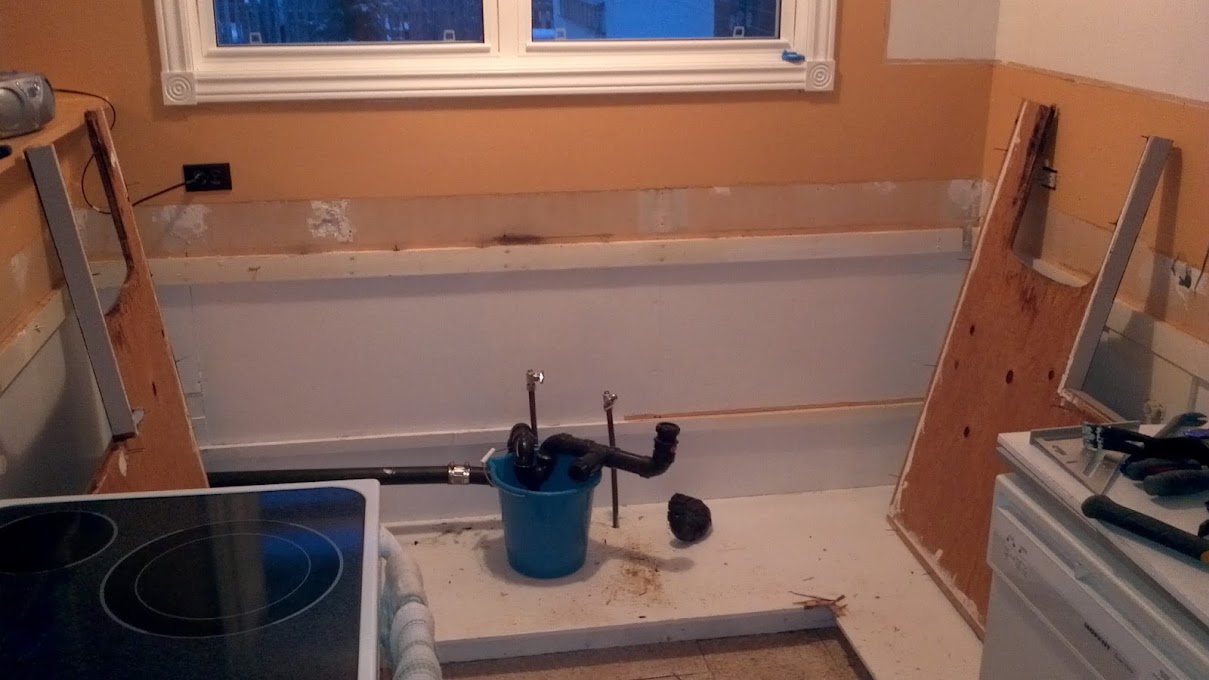
In anticipation of the arrival of the cabinets, and to get a head start on the project, demolition was begun at the beginning of December.
I was away for work when the cabinets arrived, so I was greeted upon my return by a living room full of boxes. Included was the new built-in dishwasher.
There was some plastering work required following the dismantling of the old built-ins. Also, some minor electrical work, including wiring up an outlet for the microwave, and providing power to the new dishwasher.
The floor tiles had to be removed, and the subfloor screwed down to the joists to remove the ancient squeaks.
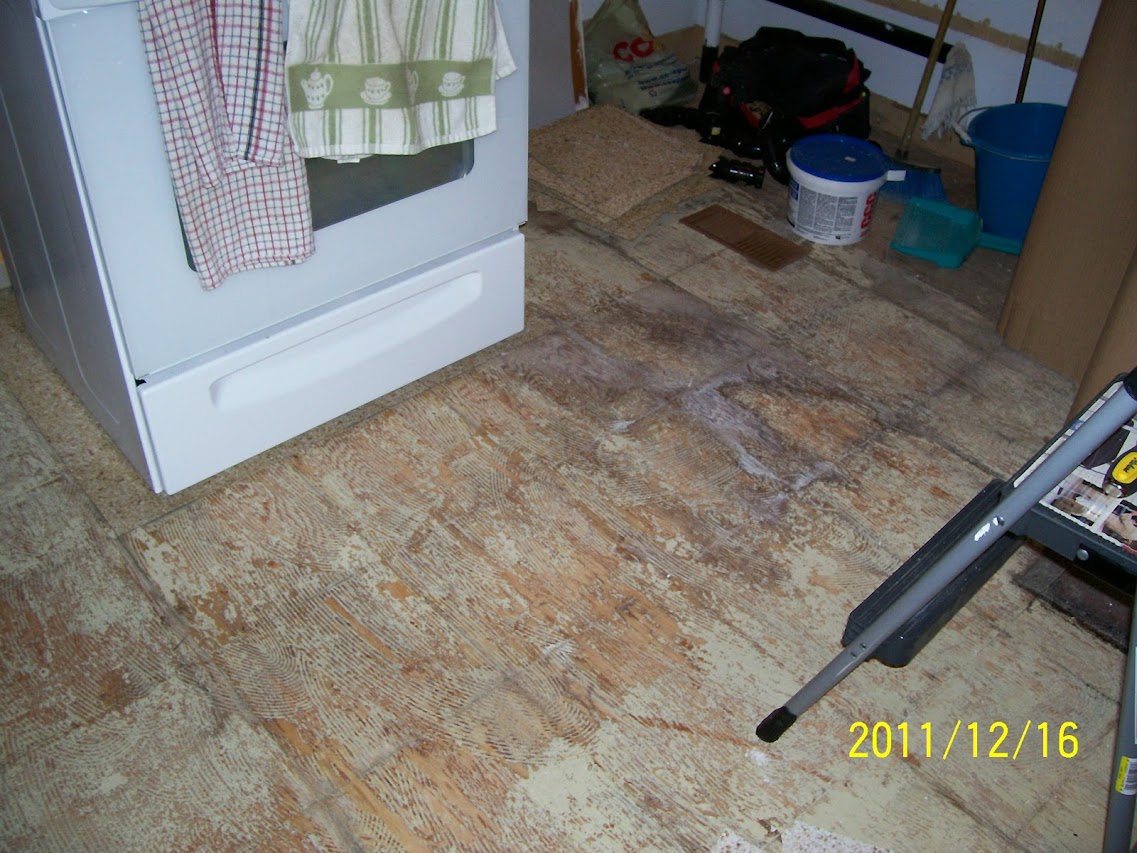
Painting was done prior to the cabinet installation, since that was easier to do when not worried about making a mess over the new surfaces. Any required touch-ups could be done after.
One major issue was the floor being unlevel. With a finished basement below, there was little recourse but work with the .5" drop between the outside wall and the dining room door. For this reason, I started with the tallest cabinet, carefully located it, and then levelled the uppers from that point back to the outside wall. If I were out in my measurements, there were spacers I could put in, but it was not necessary.
With the uppers in place and secured, I could start the more complicated process of putting the lower cabinets in. This was challenging because I had to get hot water to the dishwasher, and have the drain come back. The large corner cabinet went in and out a few times until I was happy with the solutions for that.
With the floor slanting so much in all directions, it was a real challenge making everything level, and lots of spacers were used. Installing the flooring was put off until after the cabinets, so that it would help cover up the gaps.
The smaller corner cabinet was also fun to deal with, because the drain had to go through the bottom of it, and the vent out the back. Careful measurements were required to get all that to line up.
Doing most of it by myself, all this work was taking longer than I expected, and spanned the Christmas holidays. That also caused delays, so the project was going into January. At least it was looking promising.
With the festivities out of the way, work progressed again. I had someone come in to do the counter tops since I did not have either the tools or the knowledge to install them. A drill bit had to be borrowed to mount the faucet in the granite sink.
Anyone who can use a level and a screwdriver can install cabinets, so the only thing I could really take pride in was my plumbing. I made a hatch to access the dishwasher pipes, and everything works perfectly.
The first batch of homemade bread in the upgraded kitchen!
Now that this side of the kitchen is new and more functional than ever, plus there is more counter space and more storage, I can rest, right?
Random Ramblings on Scattered Subjects at Irregular Intervals.
2012-01-22
2011-10-15
Kitchen Renovation - Phase 1
We needed a new refrigerator. The old one was getting on in years, and starting to look worse for wear. It still worked fine, but the plastic, and duct tape, were beginning to fail occasionally allowing items to fall out when the door was opened. We could use a little larger one too.
The existing space was measured, and an appropriate new appliance was purchased. I wasn't home when it was delivered, and was surprised to find that door stops had to be removed to fit it through the openings. What's worse, is that they cut the flooring to make it fit under the upper cabinet. Apparently, what was supposed to be about 1/4" of clearance, was 1/8" too high. So much for published specs.
So, here we were with the floor ruined, and upper cabinet doors that could not be opened because the top of the fridge was humped up slightly in the middle. Also, since the unit could not be tipped back, the door fell open, not closed. It was not a good situation, so I decided to modify the kitchen.
The first idea was to cut the upper cabinet at the bottom of the middle shelf and shorten the doors. This would have fixed the height problem, but another issue had arisen. The new fridge was so deep, that it made accessing the range on the opposite wall difficult. With the oven door open, there was very little room to stand. Next solution was to move to another wall.
The adjacent wall had only upper cupboards, and a table underneath. We didn't need the table, since all eating could easily be moved to the dining room. With the bottom two shelves from the middle cupboard removed, there would be plenty of space for the new fridge.
The removed shelves were, of course, the perfect size to close up the sides.
With the space made, all that was required was electricity. There was a rarely used outlet on the opposite side of the wall, that connected to an unused outlet for an AC wall clock we no longer had. The refrigerator was never was on its own circuit, and the new one was supposed to be much more energy effecient than any that had been in the kitchen before anyway.
I found center of the two studs, and carefully cut out a piece of drywall that was saved to go back in the opening.
A new box was installed, and a wire run from the former livingroom wall clock location.
A test fit showed lots of clearance for the new fridge.
The portable dishwasher could now occupy the former refrigerator location. This meant lots of room for accessing the range again.
All that was left to do was plaster and paint all the kitchen, which includes the back entrance.
I should point out that it was only a couple years before this that we had freshened up the kitchen with all new hardware, mouldings and paint. This is a room that seems to need constant attention. At least I was done - for now.
The existing space was measured, and an appropriate new appliance was purchased. I wasn't home when it was delivered, and was surprised to find that door stops had to be removed to fit it through the openings. What's worse, is that they cut the flooring to make it fit under the upper cabinet. Apparently, what was supposed to be about 1/4" of clearance, was 1/8" too high. So much for published specs.
So, here we were with the floor ruined, and upper cabinet doors that could not be opened because the top of the fridge was humped up slightly in the middle. Also, since the unit could not be tipped back, the door fell open, not closed. It was not a good situation, so I decided to modify the kitchen.
The first idea was to cut the upper cabinet at the bottom of the middle shelf and shorten the doors. This would have fixed the height problem, but another issue had arisen. The new fridge was so deep, that it made accessing the range on the opposite wall difficult. With the oven door open, there was very little room to stand. Next solution was to move to another wall.
The adjacent wall had only upper cupboards, and a table underneath. We didn't need the table, since all eating could easily be moved to the dining room. With the bottom two shelves from the middle cupboard removed, there would be plenty of space for the new fridge.
The removed shelves were, of course, the perfect size to close up the sides.
With the space made, all that was required was electricity. There was a rarely used outlet on the opposite side of the wall, that connected to an unused outlet for an AC wall clock we no longer had. The refrigerator was never was on its own circuit, and the new one was supposed to be much more energy effecient than any that had been in the kitchen before anyway.
I found center of the two studs, and carefully cut out a piece of drywall that was saved to go back in the opening.
A new box was installed, and a wire run from the former livingroom wall clock location.
A test fit showed lots of clearance for the new fridge.
The portable dishwasher could now occupy the former refrigerator location. This meant lots of room for accessing the range again.
All that was left to do was plaster and paint all the kitchen, which includes the back entrance.
I should point out that it was only a couple years before this that we had freshened up the kitchen with all new hardware, mouldings and paint. This is a room that seems to need constant attention. At least I was done - for now.
2009-07-17
Boondocking vs Campgrounds
Boondocking vs Campgrounds: This is a copy of the email I sent to the Central Newfoundland Morning Show on CBC Radio. They had done an interview with someone wanting to ban RVs from mall parking lots.
---
I only caught the tail end of the conversation about campers overnighting on mall parking lots, so I may have missed something (I'll DL the podcast and listen to all of it), however, I felt another view was in order.
We are doing the "vacation at home" thing, and have had to change our plans three times this summer because the various campgrounds we wanted to stay in were full. We had the options of trying elsewhere, or staying home, but what is a visitor from out of province to do when the closest park is booked up?
Getting to this island is expensive, fuel prices are expensive, and staying in a campground every night is expensive. Having the option to boondock a few nights a week may make the difference between a tourist being able to come here or not. Also, having these people in a town generally means they will be spending money there. It may not the the local campground, but they need fuel and food, and may take in some of the culturial offerings and engage in other activities available to tourists.
The few campgrounds I've stayed in since buying our little travel trailer last fall have been far removed from what I consider camping. Sites are close to each other, and you have almost no privacy, or experience of nature. You might as well be on a mall parking lot. If you take this even further, eventually canoeist and kayakers will be banned from setting up a tent on a shoreline close to a community. At least RVers eventually use are dumping station, what are those tenters doing with their waste? Ban them all! :-)
Here are a few links on the subject:
"While RV parks are the best accommodations for RVers, sometimes commercial parks are full, or perhaps the RVer simply cannot find a local park, especially if it is late in the evening. Other issues come into play as well. For instance, how tired is the RV driver? Were it not for easily accessible public parking lots and other similar locations that offer a resting place to RVers, you would see an increased accident rate. Far too often, RVers will drive too long, too late, or continue searching for an RV park way past their safety and comfort zone. Knowing that they are welcome to pull into a parking lot and get a few hours of rest anytime of the day or night is an enormous safety net for the traveler."
http://ping.fm/UfV4i
"Score a victory for RVers in their battle against the state of Maine. In a period of less than a week, the state legislature introduced a bill to ban overnight stays in RVs in any public parking lot in the state and then quickly killed the idea."
http://ping.fm/sl3k7
"I say so called because it sure doesn't look like a "Park" to me! Much more like a parking lot! Why? When you have a rig with all the amenities of home, that you can take darn near anywhere, why drive from your crowded city streets back home, only to park in a crowded "parking lot!""
http://ping.fm/7WTZH
"Defined: What is boondocking? (Free Camping)"
http://ping.fm/xCRxw
(Original Blog Post: http://haliburton.homelinux.net/strofficeview/?p=87)
---
I only caught the tail end of the conversation about campers overnighting on mall parking lots, so I may have missed something (I'll DL the podcast and listen to all of it), however, I felt another view was in order.
We are doing the "vacation at home" thing, and have had to change our plans three times this summer because the various campgrounds we wanted to stay in were full. We had the options of trying elsewhere, or staying home, but what is a visitor from out of province to do when the closest park is booked up?
Getting to this island is expensive, fuel prices are expensive, and staying in a campground every night is expensive. Having the option to boondock a few nights a week may make the difference between a tourist being able to come here or not. Also, having these people in a town generally means they will be spending money there. It may not the the local campground, but they need fuel and food, and may take in some of the culturial offerings and engage in other activities available to tourists.
The few campgrounds I've stayed in since buying our little travel trailer last fall have been far removed from what I consider camping. Sites are close to each other, and you have almost no privacy, or experience of nature. You might as well be on a mall parking lot. If you take this even further, eventually canoeist and kayakers will be banned from setting up a tent on a shoreline close to a community. At least RVers eventually use are dumping station, what are those tenters doing with their waste? Ban them all! :-)
Here are a few links on the subject:
"While RV parks are the best accommodations for RVers, sometimes commercial parks are full, or perhaps the RVer simply cannot find a local park, especially if it is late in the evening. Other issues come into play as well. For instance, how tired is the RV driver? Were it not for easily accessible public parking lots and other similar locations that offer a resting place to RVers, you would see an increased accident rate. Far too often, RVers will drive too long, too late, or continue searching for an RV park way past their safety and comfort zone. Knowing that they are welcome to pull into a parking lot and get a few hours of rest anytime of the day or night is an enormous safety net for the traveler."
http://ping.fm/UfV4i
"Score a victory for RVers in their battle against the state of Maine. In a period of less than a week, the state legislature introduced a bill to ban overnight stays in RVs in any public parking lot in the state and then quickly killed the idea."
http://ping.fm/sl3k7
"I say so called because it sure doesn't look like a "Park" to me! Much more like a parking lot! Why? When you have a rig with all the amenities of home, that you can take darn near anywhere, why drive from your crowded city streets back home, only to park in a crowded "parking lot!""
http://ping.fm/7WTZH
"Defined: What is boondocking? (Free Camping)"
http://ping.fm/xCRxw
(Original Blog Post: http://haliburton.homelinux.net/strofficeview/?p=87)
2009-02-12
100PUC W4/D2/C1 and Winter Activities
100PUC W4/D2/C1 and Winter Activities: I put off doing push ups for a day to allow my neck to heal a bit more, and today I felt it was good enough to try day 2 of week 4. It took everything I had in me, but I was able to once more complete the minimums, for 72 in total. I have a feeling I'll be repeating week 4.
This morning I went for a ride on my father-in-law's snowmobile. I usually get out on it once or twice a winter. Today I wanted to scout out some of the trails to see which were suitable for skate skiing. I took the rail bed up to Lewisporte Junction and back. From the industrial park I cut across to the bogs and made my way up to Scissors Pond and then into Airways Pond, before returning home for lunch.
After the meal had some time to settle, I grabbed my skate skis and the dog, jumped aboard the truck, and drove up to the end of town. The route I chose is the 3km one I use in the summer for sprinting. It was the smoothest, and the flattest, for my learning how to skate on snow.
For the past 4 years I have been using a cheap pair of non-wax/fish scale, traditional style skis. I bought them to compete in the first winter Raid Avalon adventure race. It took me a while to get used to having these long sticks on my feet, and I fell down often. I do not fall anymore, and take them all over the place, treating them much like snowshoes. They are, however,very slow, and showing their age.
Last spring, just before the final flake of snow melted, I bought a nice skate ski package from The Outfitters in St. John's. Being end of season, I saved hundreds of dollars. Being the end of the season, I was only able to use them once, briefly, on some slush before putting them away.
This winter I have been impatiently waiting for snow enough to accumulate to get out and really use them. I've risked my old skis three times on exposed rocks and sticks, and rough trails, since conditions have not been suitable for skate skiing until now, and this is still far from ideal.
Today I managed to get in a bit of training and muscle adapting to this new style, but I had to revert back to the old diagonal motions often. It was probably 30% skate and 70% traditional. Lifting the ski after pushing, and keeping it from digging into the loose snow was a challenge. I could only get in a couple dozen strides before pulling the skis back together and shuffling for a bit to catch my breath, and let the muscles relax from the new efforts.
I was surprised how well I was able to diagonal ski on these all glide skis. There are no fish scales or kick wax to push against, yet I could move as fast, if not faster than with my old skis. My nice new poles with the comfy hand straps had a lot to do with this. This gave my arms more of a workout too. Going down the slight grade on the way back, I was able to just glide and double pole for a while at a fun speed.
While not yet able to skate ski any real distance, and not at all graceful, it will come in time. There are still a few weeks of winter remaining, and each outing will bring improvement. This winter should allow me to build a good base for next winter, and I have yet to fall down with the new skis.
(Original Blog Post: -*http://haliburton.homelinux.net/strofficeview/?p=82)
This morning I went for a ride on my father-in-law's snowmobile. I usually get out on it once or twice a winter. Today I wanted to scout out some of the trails to see which were suitable for skate skiing. I took the rail bed up to Lewisporte Junction and back. From the industrial park I cut across to the bogs and made my way up to Scissors Pond and then into Airways Pond, before returning home for lunch.
After the meal had some time to settle, I grabbed my skate skis and the dog, jumped aboard the truck, and drove up to the end of town. The route I chose is the 3km one I use in the summer for sprinting. It was the smoothest, and the flattest, for my learning how to skate on snow.
For the past 4 years I have been using a cheap pair of non-wax/fish scale, traditional style skis. I bought them to compete in the first winter Raid Avalon adventure race. It took me a while to get used to having these long sticks on my feet, and I fell down often. I do not fall anymore, and take them all over the place, treating them much like snowshoes. They are, however,very slow, and showing their age.
Last spring, just before the final flake of snow melted, I bought a nice skate ski package from The Outfitters in St. John's. Being end of season, I saved hundreds of dollars. Being the end of the season, I was only able to use them once, briefly, on some slush before putting them away.
This winter I have been impatiently waiting for snow enough to accumulate to get out and really use them. I've risked my old skis three times on exposed rocks and sticks, and rough trails, since conditions have not been suitable for skate skiing until now, and this is still far from ideal.
Today I managed to get in a bit of training and muscle adapting to this new style, but I had to revert back to the old diagonal motions often. It was probably 30% skate and 70% traditional. Lifting the ski after pushing, and keeping it from digging into the loose snow was a challenge. I could only get in a couple dozen strides before pulling the skis back together and shuffling for a bit to catch my breath, and let the muscles relax from the new efforts.
I was surprised how well I was able to diagonal ski on these all glide skis. There are no fish scales or kick wax to push against, yet I could move as fast, if not faster than with my old skis. My nice new poles with the comfy hand straps had a lot to do with this. This gave my arms more of a workout too. Going down the slight grade on the way back, I was able to just glide and double pole for a while at a fun speed.
While not yet able to skate ski any real distance, and not at all graceful, it will come in time. There are still a few weeks of winter remaining, and each outing will bring improvement. This winter should allow me to build a good base for next winter, and I have yet to fall down with the new skis.
(Original Blog Post: -*http://haliburton.homelinux.net/strofficeview/?p=82)
2009-02-11
Lightweight Linux
Lightweight Linux: The computer I am using for my web server is an old Compaq DeskPro 4000 I bought second-hand many years ago. It has an Intel Pentium II 233MMX CPU, 256MB RAM, and a 13GB HDD. It is running the standard LAMP: Debian Etch GNU/Linux, Apache2, MySQL, and PHP.
It came off server duties for a little while while I tried to make it a desktop system for general family and guest use, but even with XFCE or Fluxbox I was not happy with the speed. As a web server it is also slow, but I can live with it.
For a while it was command line only, but I got tired of using wget to download CMS updates and so on. I'd have to use another computer to edit the HTML files, or suffer through Nano. Yesterday I decided to put Xwindow on it, and go with the Fluxbox window manager. This combination should not slow down the system too much, and I only have to start X when I need it.
On the command line I used:
File Manager: Midnight Commander (MC)
Email: Mutt
IRC: irssi (usually through Screen)
Text Editor: Nano
Web Browser: Lynx
Package Installer: Apt-Get (sometimes Aptitude)
I will continue to use these applications, but now with the GUI installed, I wanted some lightweight graphical programs too. They have to take up very little HDD space, and not have too much overhead with running so as to slow down the serving of web pages too much.
Here is what I have decided to start with:
File Manager: ROX-filer
Text Editor: NEdit
HTML Editor: Geany
Web Browser: Dillo
Audio: XMMS
Image Viewers: feh and GQview
Those were installed today, and will be tried out over the next little while. If anyone has a suggestion for another I should look at, leave a comment.
(Original Blog Post: http://haliburton.homelinux.net/strofficeview/?p=74)
It came off server duties for a little while while I tried to make it a desktop system for general family and guest use, but even with XFCE or Fluxbox I was not happy with the speed. As a web server it is also slow, but I can live with it.
For a while it was command line only, but I got tired of using wget to download CMS updates and so on. I'd have to use another computer to edit the HTML files, or suffer through Nano. Yesterday I decided to put Xwindow on it, and go with the Fluxbox window manager. This combination should not slow down the system too much, and I only have to start X when I need it.
On the command line I used:
File Manager: Midnight Commander (MC)
Email: Mutt
IRC: irssi (usually through Screen)
Text Editor: Nano
Web Browser: Lynx
Package Installer: Apt-Get (sometimes Aptitude)
I will continue to use these applications, but now with the GUI installed, I wanted some lightweight graphical programs too. They have to take up very little HDD space, and not have too much overhead with running so as to slow down the serving of web pages too much.
Here is what I have decided to start with:
File Manager: ROX-filer
Text Editor: NEdit
HTML Editor: Geany
Web Browser: Dillo
Audio: XMMS
Image Viewers: feh and GQview
Those were installed today, and will be tried out over the next little while. If anyone has a suggestion for another I should look at, leave a comment.
(Original Blog Post: http://haliburton.homelinux.net/strofficeview/?p=74)
Subscribe to:
Posts (Atom)