2001-08-05

A Whale of a Time Aboard Careless Whisper (2001)


  Originally written in 2001

A Whale of a Time Aboard Careless Whisper
(July 29 to August 1, 2001)


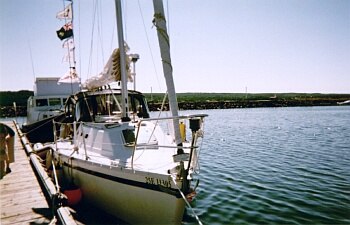
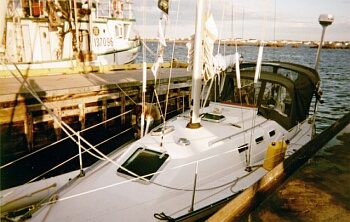
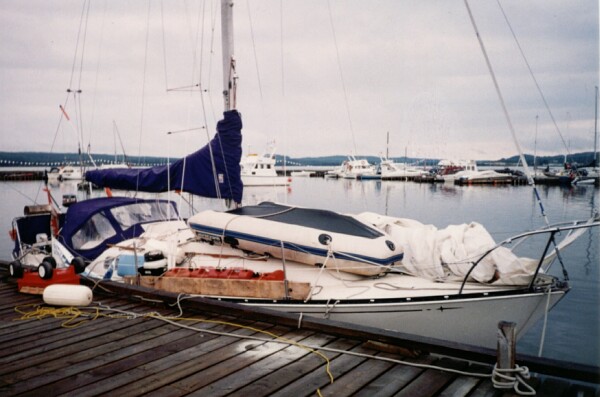
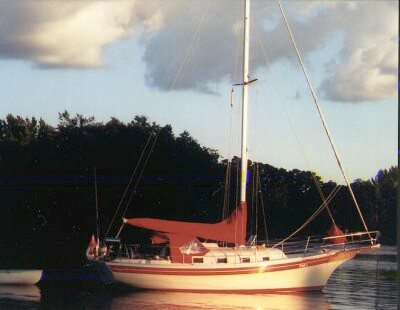
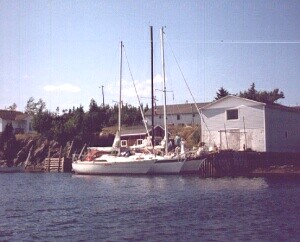
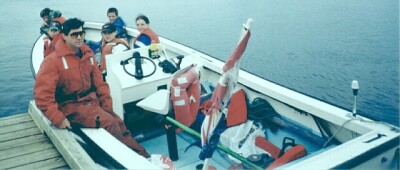
Careless Whisper at the Lewisporte marina
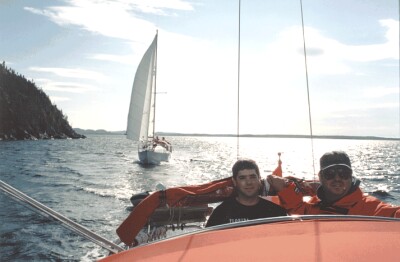
Mark 10:31 to our starboard
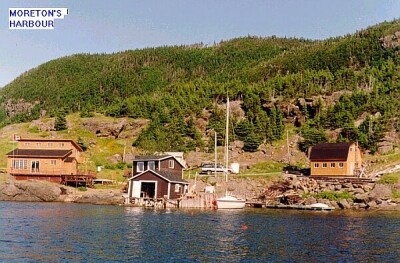
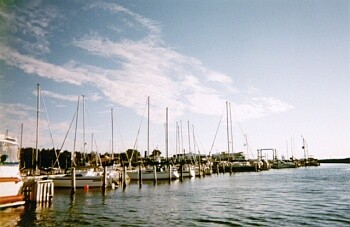
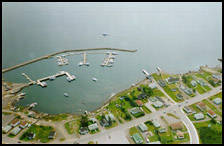
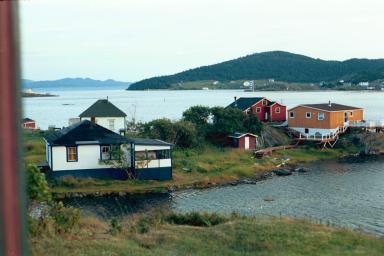
Moreton's Harbour Marina
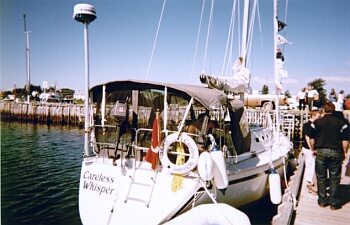
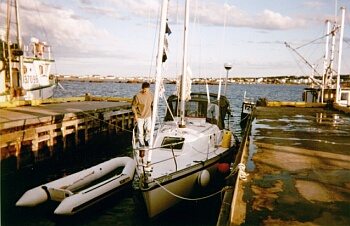
Careless Whisper safe at Musgrave Harbour
Edward checking over the boat after docking
Edward checking the boat after docking
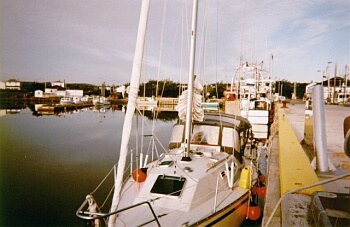
Snugged down at Catalina
Docked at Catalina
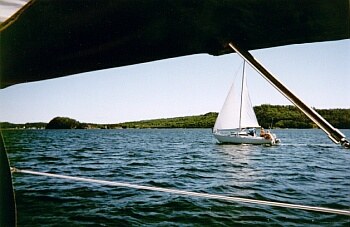
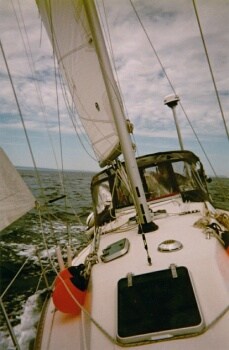
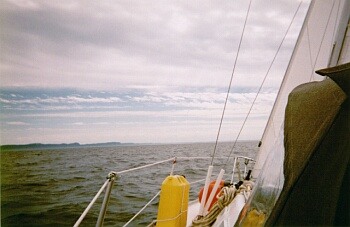
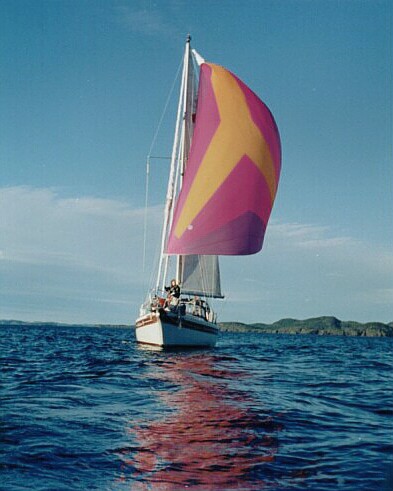
Finally getting in some sailing
Getting in some sailing
Sailing across Conception Bay
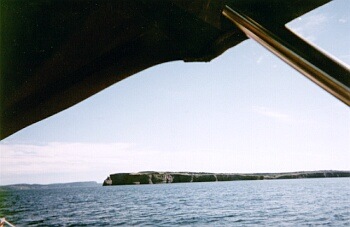
Nearing Bell Island
Bell Island
Arrival at the RNYC marina
At the RNYC marina
The sailing vessel Careless Whisper is a very nice 1985 CS 30. She is was well outfitted with electronic gear, and a comfortable vessel for coastal cruising. Her owners, Julie and Edward, while relatively new to sailing, are quite capable. They had just returned to Lewisporte following their participation in a small week-long local flotilla, and wanted an extra hand to help get the boat back to their home port at the Royal Newfoundland Yacht Club marina. My sailing and navigation skills would only be a back-up to theirs in case the weather turned bad, or some emergency arose.

Sunday, July 29: By the time we loaded up, and said our good-byes, it was 1100 when we cast off the dock lines and got underway. Winds were forecasted to be an ideal Westerly 15 to 20 knots, but never actually got much over 10, so we had to motor off and on. An Abbott 22, Mark 10:31, containing our friends Carolyn, Peter and Clara accompanied us part-way across Embree, but soon slipped behind, so we bid them farewell over the radio. Also on the VHF was Just Carrying On who, along with Meagan Rae, was returning to Lewisporte from our destination, Moreton's Harbour. We arrived at the private marina there at about 1700, having only enjoyed a couple short sails. We did, however, see some whales off Western Head as we passed inside Gull Island; foreshadowing the rest of the trip.

Monday, July 30: I had my alarm set for 0600, but woke up at 0530. While waiting for the others to rise I went outside to inspect the day. It was very calm, but a light breeze was rustling the flags by the time we departed at 0730. About half way to Twillingate a whale surface a couple meters in front of the boat. This, however, was just the first one of the day, and the many we would see while motorsailing through Notre Dame Bay. We took a different route than I had gone on previous voyages, going between Change Islands and Fogo. I was looking forward to this section, but had a nap in my aft berth after lunch and missed it. I am not normally a morning person, and rarely do I nap, but early mornings and long days on the water can be tiring. The plan was to put in at Seldom for the night, but with lots of daylight left, we decided to see if we could make Lumsden. Plagued still by the light and fickle winds, we did not cover as much distance as we hoped, and decided to pull into Musgrave Harbour. It was a much nicer arrival than the last time I sailed into the community (aboard Windthrush). The same dock space was available, and that evening we tuned up the rigging which had slackened slightly with all the sailing Julie and Edward had done that summer.

Tuesday, July 31: Once again I awoke at 0530, and got dressed before my hosts in the forward berth. Departure took place around 0700. We were greeted once again by familiar light winds, although they were variable from the North and a little cool for the time of year. While motorsailing, we attempted to keep our SOG at 6 knots and managed to average a very reasonable 5.7. Our port of call for the evening was Bonavista, but once more ahead of schedule, and experiencing reasonable weather, we carried on to Catalina, passing close aboard the only cardinal buoy I have seen in Newfoundland waters. (We saw it flashing at night from Windthrush, but couldn't find it in the list of lights at that time.) The day was again filled with whales and even some close encounters off Cape Freels. One was continuously slapping its tail on the water all the while we were approaching the entrance to Catalina. This was new, yet unexplained behaviour to me. I had been wearing my sunglasses all day and forgot to take them off, so I was experiencing more darkness than there actually was. I am using the adjustment my eyes had to make as an excuse for not finding the range, since I am normally known for my keen eyesight. After making the twists and turns to make our way into the harbour, we found that the kind people of Catalina had a new wharf constructed just for us, or so I would like to think. You could still smell the paint on the wood, but the power, unfortunately, was not yet looked up.

Wednesday, August 1: Departure took place at 0700. This day the light winds were mixed with some fog, and that gave Julie an opportunity to more seriously practice her navigation since we may have to go long distances without being able to see any landmarks, or much of anything for that matter. She planned us a safe route to the marina and carefully entered it into the GPS. Along with the radar, we were well prepared to handle the reduced visibility with safety and confidence. As it turned out, we didn't really need the electronic gadgets. The fog cleared well before we had to make our way Between Grate's Point and Bacalau Island. While we were making our way through the channel, we noticed two other sailboats. They were hugging the cliffs and seemed to be gaining on us. If we abandoned our safe track and kept closer to shore ourselves, we could shave a little time off our voyage, so that is what we did. This worked out well, except for the obsticle course of many net buoys I had to weave through on the East end of the channel. Getting just an hour or so away from the marina, the wind decided to picked up and help speed us on our way. The sun was also out by this point too, and the last part of the trip became the most enjoyable. Just outside the channel to the marina we dropped sail and motored in while several other sailboats were heading out for their normal Wednesday evening races.
The voyage was marked by many whale sightings (Which are hard to get good picture of with a disposable camera and no zoom!) and light winds, but the most memorable part was the generosity and kindness of the boat owners. They took very good care of me, and saw that I was not out of pocket myself as long as I was with them. I wish Julie and Edward all the best, and as with most people I have sailed with, hope I can go boating with them again sometime.

- Peter Haliburton © 2002
   All displayed photos, except Moreton's Hr. Marina, © Peter Haliburton 2001


Trip Log Summary
TIME LOCATION DISTANCE
(LEG/TRIP)
SPEED
(LEG/TRIP)
COMMENTS
Sunday, July 29, 2001
1100 Lewisporte - - Departed the LYC marina for Moreton's Harbour
1700 Moreton's Harbour 27.2/27.2 4.7/4.7 Arrived at the marina
Monday, July 30, 2001
0730 Moreton's Harbour - - Departed
1830 Musgrave Harbour 54.9/82.1 4.8/4.7 Arrived
Tuesday, July 31, 2001
0700 Musgrave Harbour - - Departed
2115 Catalina 80.9/163.0 5.7/5.1 Arrived
Wednesday, August 1, 2001
0700 Catalina - - Departed
1930 RNYC Marina 62/225 5.0/5.1 Secure at destination

2001-03-04

Boating Background


J. Peter Haliburton
~ Boating Resume ~
NARRATIVE

Wells' Point, Exploits Islands, NFGrowing up in the coastal community of Lewisporte, NF, I spent much of my life on the water. I remember going out to Exploits Islands, at the mouth of the Bay of Exploits, in my grandfather's boat while quite young. The trip would take three to four hours, not counting the stop for a lunch, to cover the roughly 18 nautical miles. In my early teens my father got our first boat. It was a 19' cuddy speedboat with a 135hp Johnson outboard for power. Exploits could be reached in a little over 30 minutes in that rocket. The same boat is still making that trip, now with its third owner, after more than 20 years. The engine has been replaced with a larger one though, and it is even faster. 

Our present boat ready to head out to Exploits (1999)Our next vessel was a Trojan cabin cruiser. It was nice, but expensive to operate and maintain. It was in turn sold in favour of an older cabin cruiser with a diesel engine. That boat was traded on a couple of old wooden boats belonging to my uncle. Those didn't even make it into the water. There was a fiberglass speedboat for a short period of time, but my siblings and I were all long gone by then, and my parents rarely went boating during that period. So, eventually, there was no boat at all, and my grandparent's old house at Exploits began its descent into a sorry state of disrepair. 


Exploits had always been our destination. Since it is a pair of islands, a boat was the means of getting there. We rarely went elsewhere. We passed by the other islands so quickly we hardly noticed they were there. The wildlife and other sights were just a blur. The boat ride was fun, but just a means to an end.
Parker and I in the current boatMy family and I moved back to Lewisporte in the late summer of 1994 after many years away. In the spring of 1996 we got our first boat to facilitate the repair of the old Wells family home out on the island. It is a modified Bayrider, 19' open speedboat with a 70hp Mercury outboard. On a good day, with a light load, it can make Exploits in as little as 40 minutes, but usually the trip takes about 50 minutes. This boat serves as a means to transport material for the repair and upkeep of the house my grandfather built at Exploits. Enjoyment of the trip is short and somewhat limited. 


Peter Watkins' Bayfield 36 in 1996During the winter of 1996/1997 I got to know Peter Watkins. He had grown up in the area, but had spent most of his working life in Ontario. He was a recreational sailor who had spent years sailing on Lake Ontario and the BVIs, crossed the Atlantic once, taught sailing, and was a great promoter of sailing. On June 16, 1997 I got my first trip on a sailboat when we brought his Bayfield 36, Windborne III, over to Lewisporte from the Triton shipyard where it had spent the winter. 


This was when I learned that the joy is in the journey, not just the destination, and that a sailboat is the vehicle to do it in. Even my wife, who is normally afraid of the water, and disliked boats in general, enjoyed being on his sailboat. There was something very different about this mode of transportation.
LACC signJuly of that year a flotilla of boats from Ontario and beyond made their way down to Bonavista, NF for the arrival of the Matthew. This was all in celebration of the 500 years since the discovery of Newfoundland by John Cabot. (The Vikings had preceded him by another half millenium, but that celebration is in the year 2000.) When the Central Newfoundland chambers of commerce chartered Peter's boat for the trip from Lewisporte to Bonavista to be a part of this, I was the navigator and second in command. This was a fantastic experience. 


Peter Watkins and I in the CL14 on Woolfrey's PondDuring the summer of 1997 I had the opportunity to sail Peter's CL14. I had this fun little dinghy on the pond at the end of our street, and in Lewisporte harbour. The third boat he brought down from Ontario was an Abbott 22, but I didn't even get to see this one since it was sold the previous summer, and wound up back in Ontario. The CL14 was sold locally in 1997. Things had not gone quite as Peter expected. 


Windborne returning from Exploits (1997)Windborne III was used for charters and sailing lessons. I helped out with those whenever I was able to, and while onboard, I got to do my basic sailing course as well. The cruises often involved day trips to Exploits where the guests usually had lunch at Devon House before returning to Lewisporte. When not out on business, we enjoyed day trips all over the Bay of Exploits. Life was good. In October we sailed her back to Triton as part of our intermediate training. 


1998 offered a large variety of boating experiences. In that year Peter Watkins and I designed our own basic coastal navigation course and put off our first class. We had a great time with the bunch of students we had in Musgravetown. They all did very well. This was when Peter was stricken with a serious illness and closed his business. We had to postpone the second weekend of the class for much longer than expected, but he was able to complete it, and planned another class closer to home for the fall. 


Peter Watkins' Bayfield 32 at the Lewisporte Marina with the skipper on the bowEarlier in the fall he had traded down from the Bayfield 36 to a Bayfield 32, Paws II. The swap took place at the Triton yard on a cold wet day in April. I got my first experience rigging on this boat, and delivered it, along with another fellow, to Lewisporte on June 8. That was a mean 7.5 hour trip. There was fog, lots of icebergs, and 8' to 10' seas. On Windborne there was a radar to help get through the fog, but on this trip we were lucky it never got thick enough for us to lose sight of the shore, or the ice, for very long. 


Lewisporte marina complex in 1998With the expansion to Lewisporte's marina in 1998 the number of sailboats increased. Two of the boats were owned by first-time sailors, so I got to help in the rigging of a C&C 25 and an Aloha 8.2, as well, I was involved with the tune-up a Newport 30's rig. I was also very active in the launch of the C&C 25. 


On July 25 I was aboard the Aloha 8.2 on a trip with three of the boats to Luke's Arm, with a stop-over in Comfort Cove. I was acting as advisor and crew for the owner on one of his first trips of any distance. Later, on August 3, I travelled on the same boat as guide for a trip it, and a Tanzer 22, made to Exploits Islands, Moreton's Harbour, and Swan Island. My mother had her first trip on a sailboat during this time. I sailed on the T22 going from Swan Island to Exploits. 


Me at the helm of Windborne in 1997There was not much time for sailing after that as I had to concentrate on getting some work done on the cabin before winter. For the rest of the summer and fall, boating was restricted to my own boat.
In January 1999, Peter Watkins and I put off our second basic coastal navigation course. This one was held in Lewisporte, but the students came from all over central Newfoundland. Again we had a great bunch of people who did very well. Doing these classes has been more like a social gathering than being in school, and that seems to help our older students. 


The Rachel sail/motor/row dinghyOn April 7th the plans to build a great little dinghy arrived. I am continuing to learn the skill necessary to complete its construction, and to track down all the required materials. I hope to have Rachel in the water before July. 


Due to exceptional spring weather, work on all the sailboats was able to commence in mid-April. Thus, the launch of the 4 sailboats requiring a crane is scheduled for Saturday, May 8. This is about a month earlier than normal. I was planning on a day trip to Exploits to check on the the cabin, but with pack ice still haunting the bay, my helping with getting the sailboats in the water looks more likely.
I hope to be able to do some racing with Blaine Duff on the C&C 25 the summer of 1999. Having spent two summers learning to sail, and just cruising around, I am ready to try something new. His is a fast boat and I hope we can do well with it. 


That took us up to the spring of 1999, and it is now the winter of 2000. This is a good time to reflect on the past season. As these memories are fresher than the ones covered previously, I will go into a little more detail on the various events.
The Rachel is still not started. There wasn't room in the budget for the $500-$800 cost to build it. Somewhere down the road I will construct and sail her though. She is a good boat for my son to use and learn on.
Buckshee heading off to race at BotwoodIt was the first summer I did not get to sail with Peter and Carolyn since my introduction to sailing. Schedules and other matters kept us from being on the water together. In fact, other than an afternoon sail aboard Ralph Miller's Tanzer 22, I had all my trips on the C&C Buckshee. 


Blaine, her owner, had only gotten into sailing the summer before I did. He was one of at least three groups of people who went on a cruise with Captain Watkins and had a boat of their own not too long after. This was also the case with Leslie and Wayne Wall and their Aloha 8.2, and the Barrett's Bayfield 25. The Peytons are still looking for their perfect boat. 


On May 15, 1999 I was giving Blaine a hand with a few things on his boat. The winds were light, maybe 5 knots, so we decided it would be a good time to try his new asymmetrical spinnaker. I had helped fly one one a couple years previous on Windborne, and there was an instruction manual, so with a word of warning from Peter to tape up everything that couls cause a rip, off we went. We managed to figure out how to run all the lines, and the trial run was successful. Now we were ready for those light wind races in Botwood. 


The iceberg aground off Ochre PitMy second trip on Buckshee was on the 17th. I thought we were just going to give the boat a short run around the harbour, and was only prepared for that. After we got so far out, however, we saw a huge iceberg aground off Ochre Pit Island, so we had to go take a closer look at it. I was about 3 hours overdue getting home, but it was worth it for the grand sights and the great sailing. 


On June 24th, following the weekly Wednesday race in Botwood, Blaine and I decided to run out to Exploits before heading back to Lewisporte. The winds were light, so we had to motor most of the way, but it was a wonderful warm and sunny day. Here and there we could see the remnants of icebergs aground in a cove, or drifting aimlessly about the bay. 


C&C25, Aloha 8.2 and Bayfield 32 at Luke's Arm (1998)Racing aboard Buckshee was more work than I expected it would be. With just the two of us relatively inexperienced sailors against a field of seasoned vets, it was a wonder we did as well as we did. Blaine did most of the helm work, so I was rushing around the decks, trimmed the sails, checked the charts and GPS, cooked the meals, and generally beating myself out and up. I can now relate to the happenings as I watch the America's Cup races. 


In August, on a sunny afternoon with about 10 knots of wind I took Buckshee out myself for my first single-handed sail since 1997 in the CL14. Being alone on a boat is oddly relaxing, even though you need 6 arms and to be in several places at once. I had made a couple runs in my speedboat by myself, but when sailing you become one with your environment. You, the boat, the water and the wind all working together. For a while I was able to balance the sails, tie off the tiller, and ride on the bow. I look forward to the day when I can have a sailboat of my own, of any size. 


Leslie, Wayne, Roxanne and I aboard Jo-Lain (1998)Other than an enjoyable, and that expected afternoon with Ralph on his T22, much of my summer was spent on a boat with someone I didn't really know that well, and never socialized much with away from the docks. It is even more interesting that my last four sails on his boat where done without Blaine aboard. These were my first opportunities to truly skipper a sailboat, not just look after one while the skipper was napping, or otherwise occupied. It is good to have someone trust you enough to give you the keys to their boat and permission to use it within the harbour pretty much at whim. 


My wife, Roxanne, and son, Parker, got their only sail of the season on October 3rd. This was also my last sail of the season, but I did get out in my boat again. Next summer could be very different again. The Aloha was sold in the spring, and was been relocated. leslie and Wayne are still missed by their fellow sailors. The owner of a Tanzer 26 I was hoping to get out on has moved, and his boat up for sale. And, just recently, I found out that Blaine has been transfered and his boat is up for sale (sold winter 2000). 


FRIENDS: Carolyn, Peter and Roxanne at Samsons Island in 1998So far in 2000 I have had just the one sail, but it was a good one. For details click here. In November 2000 I embark on my first real offshore and international delivery/crewing experience. I'll be helping bring a Bayfield 32 down to the Bahamas for the owner's winter escape. This is the next logical step for me, and my first time out of the country. I'll be looking for other crewing opportunities while I'm down there. If you know of anyone needing crew there around the end of November, let me know, or let them know about me. 


To date, I have accumulated over 300 hours of sailing time
and about 1500 nautical miles traveled.


This page was written on 1999/05/05 and last updated on 2001/03/04.

2001-01-26

Marine Industry Careers

INTRODUCTION

I have been researching the life of a professional seafarer to see if this is indeed the career route I now wish to follow. Since others might also find this information useful, I'm putting a summary of what I compile online. I'll develop this page further as I learn more about the wide and various positions available to the professional mariner.

DEFINITIONS

Captain (Master, Skipper): The person in overall command of the operation of a vessel. They supervise the work of the other officers and the crew. They set course and speed, maneuver the vessel to avoid hazards and other ships, and periodically determine its position using navigation aids, celestial observations, and charts. They direct crew members who steer the vessel, operate engines, signal to other vessels, perform maintenance and handle lines, or operate towing or dredging gear. Captains insure that proper procedures and safety practices are followed, check that machinery and equipment are in good working order, and oversee the loading and unloading of cargo or passengers. They also maintain logs and other records of ships' movements and cargo carried.

Deck Officers (Bridge Officers, Mates): Assistants to the captain. Merchant marine vessels - those carrying cargo overseas - have a chief or first mate, a second mate, and a third mate. Mates oversee the operation of the vessel, or "stand watch" for specified periods, usually 4 hours on and 8 off. On smaller vessels, there may be only one mate (called a pilot on some inland vessels) who alternates watches with the captain.

Deckhands (Seamen): Operate the vessel and its deck equipment under the direction of the ship's officers, and keep the non-engineering areas in good condition. They stand watch, looking out for other vessels, obstructions in the ship's path, and aids to navigation. They also steer the ship, measure water depth in shallow water, and maintain and operate deck equipment such as life boats, anchors, and cargo-handling gear. When docking or departing, they handle lines. They also perform maintenance chores such as repairing lines, chipping rust, and painting and cleaning decks and other areas. Seamen may also load and unload cargo. On vessels handling liquid cargo, they hook up hoses, operate pumps, and clean tanks. Deckhands on tugboats or tow vessels tie barges together into tow units, inspect them periodically, and break them apart when the destination is reached. Larger vessels have a boatswain (bosun) or head seaman.

Purser: The main purpose of the purser is to see to the comfort of the passengers. This position would only be found on cruise ships, ferries or similar vessels transporting paying passengers.

Engineers: They operate, maintain, and repair propulsion engines, boilers, generators, pumps, and other machinery. Merchant marine vessels usually have four engineering officers: A chief engineer and a first, second, and third assistant engineer. Assistant engineers stand periodic watches, overseeing the operation of engines and machinery.

Marine Oilers: People who work below decks under the direction of the ship's engineers. They lubricate gears, shafts, bearings, and other moving parts of engines and motors, read pressure and temperature gauges and record data, and may repair and adjust machinery.

Pilots: They guide ships in and out of harbors, through straits, and on rivers and other confined waterways where a familiarity with local water depths, winds, tides, currents, and hazards such as reefs and shoals is of prime importance. Pilots on river and canal vessels usually are regular crew members, like mates. Harbor pilots are generally independent contractors, who accompany vessels while they enter or leave port. They may pilot many ships in a single day.

GENERAL INFORMATION

A typical deep sea merchant ship has a captain, three deck officers or mates, a chief engineer and three assistant engineers, plus six or more seamen and oilers. Depending on their size, vessels operating in harbors, rivers, or along the coast may have a crew comprising only of a captain and one deckhand, or as many as a captain, a mate or pilot, an engineer, and seven or eight seamen. Large vessels also have a full-time cook and helper, while on small ones, a seaman does the cooking. Merchant mariners also have an electrician, machinery mechanics, and a radio officer.

Merchant mariners are away from home for extended periods, but earn long leaves. Many are hired for one voyage, with no job security after that. At sea, they usually stand watch for 4 hours and are off for 8 hours, 7 days a week. Those employed on Great Lakes ships work 60 days and have 30 days off, but do not work in the winter when the lakes are frozen over. Workers on rivers and canals and in harbors are more likely to have year-round work. Some work 8 or 12-hour shifts and go home every day. Others work steadily for a week or month and then have an extended period off. When working, they are usually on duty for 6 or 12 hours and are off for 6 or 12 hours.

Some of the information I've read says that jobs in the marine industry are low paying and hard to come by. This is mostly coming from US sources. Canadian reports say there is a shortage of over 40,000 people worldwide, and that you can expect above average income.


NOTE: Much of the information contained herein was obtained from Water Transportation Occupations. This was the best source I found on the web to date.


LINKS:

2000-12-03

Not Quite the Bahamas (2000)

This account was written in 2000 upon my return home from the trip. Some of the links are broken, and there may be other problems.


Not Quite the Bahamas
(Crewing aboard Salt Heart, November 11-24, 2000) 
 
I did all my sailing lessons aboard a Bayfield 36 in 1997, and my first delivery was a Bayfield 32 in 1998. I know, or at least have met in person, the owners of 4 Bayfield 25's (3 NF, 1 ON), 1 Bayfield 29 (NS), the new owners of the B36 (ON), and the new owners of the B32 (NF). Knowing these boats so well, I have developed a website dedicated to them called Bayfield Yacht Owner Resources. I also subscribe to SailNet's Bayfield E-mail list  It was through that list I came to know about a 32' Bayfield, being prepared to set sail for the Bahamas, that was in need of one extra crew member. I replied to the message and was soon accepted to join the skipper, Bill McMaster, and his friend John Wickett, aboard the sailing vessel Salt Heart.

Me, Bill, and John

This voyage was to be the longest and furthest offshore I had gone, so a lot of preparatio\n was required. Days were spent making lists and tracking down the products I needed. Very little was available locally. More time went into trying to figure out transportation. I finally had to give up on a means of getting home until after I got there. (Travel agents are somewhat fussy about knowing exactly when you'll be returning, especially at a peak travel time. But, it was almost winter, and I didn't think I'd be in a rush to leave the Bahamas. Returning to shoveling snow was a detail that could wait.) Some of the items I purchased include harness and tether, type I life vest, near freezing capable sleeping bag, backpack, duffel bag, rigging knife, sailing gloves, C-light, and passport. There was very little room remaining in either the backpack or duffel bag after I squeezed in all the items I packed for both the temperature extremes, and a range of sailing conditions

The original plan called for me to meet up with the boat in Shelburne, NS for a November 11th departure directly to Bermuda and then on to the Bahamas after resting and reprovisioning, however, with things remaining to be done on the boat, and the workplace demands of the other two, Salt Heart was still in Charlottetown, PE at that date, so I met up with her there

It had been many years since I had traveled anywhere by bus, but it was a fairly pleasant ride over that included a total of 4 buses (Lewisporte Junction to Port aux Basque, North Sydney to Truro, Truro to Moncton, and Moncton to Charlottetown) and a ferry (Port aux Basque to North Sydney) over a day and a half, and across 3 provinces. Bill was waiting at the bus terminal when I arrived at about 2340 on Friday, November 10th, 2000. He drove me back to the boat where I got a brief tour before settling in for the night. John and his wife, Stephanie, arrived Saturday morning, and I met them for the first time. The big job for the day was to install a masthead tri-light. After designing and shaping a metal bracket, someone had to be hoisted up the mast to see how to go about installing it. That task was assigned to the boat owner, Bill, even though he was the heaviest of the 3 of us.

We attached the main halyard to the bosun's chair, and the spinnaker halyard to his harness - just in case. We rerouted the main halyard to a larger winch, and with much effort, had the skipper at the top of his boat for the first time. After marking the location of the required holes, he came back down while we fastened the light's base to the bracket, and got everything in place to make the mast attachment. The honor of the second trip up the mast went to the lightest person, me. It was cold, windy and eventually dark, but I managed to drill the two holes, tap them, bolt on the bracket and wire up the boat's new main navigation light. The hot supper at a local restaurant was most welcome after that experience. The overflowing black water holding tank was not.

Even though Bill had been living on the boat for the summer, he rarely used the head, and lost track of the last time it was emptied. With the three of us now making use of the facilities, it was soon topped up, and then some. The excess went into the bilge. We pumped it all out, and cleaned it up as best we could. It was decided not to go more than 2 or 3 days without using the macerator to empty the tank. John slept aboard with us that night, and the 3 of us began settling into life together on the boat.

Sunday's tasks included relocating and recabling the windvane control knob, filling the fuel tank, attaching the bow anchor, rerigging the SW antenna (we had used that halyard to supply parts and tools for the light installation.), and generally making the final preparations to our new home. The boat itself is a 1984 Bayfield 32C bearing hull #50. Bill had invested quite a lot in an already sound boat to make the trip safer and more comfortable. She had radar, windvane, autohelm, and amateur radio communication equipment on top of all the standard electronics. Canned food enough for the entire voyage was stashed in various locations. Fuel containers and a deflated Zodiac were lashed to the deck. Salt Heart certainly looked like a boat ready to go somewhere, as she sat a couple inches lower in the water.

The view below


On Monday morning, after saying goodbye to those who came by the marina to bid us farewell, we cast off the lines and headed out the harbour. Our intention was to go just as far as Wood Islands to get everyone used to the boat, and each other. As we neared our destination, things were going so well that we decided to carry on to the Canso Lock, and find a place just beyond that to dock. While it seemed like a good decision at the time, it was not long before the wind and seas began to pick up. 2/3 of the crew got a bit sea sick (names withheld!), the boat took some hard bangs, things were thrown about the cabin, the gimbaled stove fell apart, we lost house batteries and had to run the navigation lights using the starting battery, part of a repaired trailboard broke off, the windvane had to be retired, and for a few hours, the passage was generally miserable. Not quite the leisurely sail we had expected.

About 0400 we arrived at the Canso Lock. I'd driven over the bridge and causway several times, but this was my first time in the lock itself, or any lock for that matter. It was interesting watching the large steel structure swing out of our way. Once through, we passed two fishing boats heading north - the wrong direction as far as we were concerned. Bill went below to see where we were going to put in for a few hours rest and recovery, while I played with the engine controls and practiced maneuvering Salt Heart under power.

Port Hawkesbury was the closest town which would likely have available most anything we required. We found our way to an empty set of floating docks next to a large wharf. All the local boats had been hauled out for the winter, and we were the only vessel there - stranded behind a locked gate. It was good enough for the night, or morning as it now was. It was close to 0600 by the time we turned in, and almost lunchtime before we were up again.

After putting the wave tossed items away, we decided to move Salt Heart over to the wharf where the shore could be accessed easier. Later in the day we moved her again, this time to the other side where we would get some better protection from the expected winds. John wisely saw that we were always pointing into any winds. Most of the day was spent rewiring the boat so that we did not run into problems like we had the previous evening. My suggestions were accepted as part of the plan, and Bill and John went on an excursion to town to purchase the parts we required. I stayed behind to continue the cleanup operations. By dark we had everything up and running, better than it was before.

The forecasted strong winds arrived on Wednesday, and we decided it would be best to stay put for at least a day. It is just as well we did since the fresh water electric pressure pump gave out, and the used backup also failed to operate. Bill had a new pump stowed away that got the water flowing again, but now we were without a backup. A suitable replacement was found in Port Hawkesbury and delivered by someone at the store. We had to remind Bill how warm he was going to be once we got to the Bahamas to keep him motivated as he worked outside in the cold, wind and rain.

While Bill was working on getting water into the boat, I was forward trying to get water out of the boat. The head sink was not draining. I traced the problem to a dip in the hose. I rigged up a bracket to hold it closer to the underside of the v-berth, and we never had that problem again. We needed both sinks working with 3 people aboard.

At 1530 we checked in with Herb Hilgenberg (VE3LML, Southbound II), the expert marine forecaster from Burlington, ON, on 12.359MHz, USB. He advised us to stay where we were for a couple days since the winds were going to continue to be high. The crew of the tug, Epinette II, who were tied up next to us suggested the same thing. They were not planning to leave until Saturday. They were also kind enough to allow us to plug into their electrical. The wharf's power connection did not mate with theirs, so they would have to run their generator anyway. We only had a small heater and a light bulb to power. The heat was certainly welcome. It was, after all, the middle of November.

Thursday marked a week since I had left home. I had not packed for so many days of cold weather, since I was only supposed to have a couple days of it. Shorts remained buried deep in the duffel bag, while t-shirts became another layer under the sweaters. Some clothes had been worn 4 or more days since last washing. I needed to get a new laundry bag to replace the one I borrowed from Bill. In addition, my big flashlight had suffered massive internal injuries on the passage from Charlottetown, so I was in need of another one. Bill and John had some shopping to do as well, so we called a cab and headed into town to clean out Canadian Tire and Sobeys. Bill got a voltmeter and an ammeter to put on the house batteries to be able to keep an eye on their health. The new wiring system had not, as yet, been given much testing time, and we were planning to head offshore.

While Bill drilled more holes in the boat and installed the gauges, John and I devised a way to mount the GPS to the binnacle with parts we picked up during the shopping spree, and things we found on Salt Heart. A board across the handrail with 2 u-bolts served to adequately secure the GPS stand where it could be used by the helm, yet not block the compass, or take too much room away from hands on the rail. I made a temporary connection into the compass light's power. Bill fixed a minor electrical problem with the propane solenoid, enabling John to cook up a wonderful steak dinner on the ungimbled 2 burner stove, even though the gimbaled unit was now functional again.

Before bed, we had to swing the boat around again to face into the night's wind. I wasn't able to sleep feeling there was something wrong with the boat, so I stuck my head out the companionway for a look. The bowsprit was well over the concrete wharf, and the tide was high. The dock lines would need adjusting before a lower tide level caused the boat serious damage. While I was out working on this Bill came up to see what was happening and gave me a hand. It didn't take long to have her lying parallel again. I slept through the 0400 check and fine tuning Bill did.

I always keep a road map with my navigation gear since many of the charts I use don't have much, if any, detail on the communities. It also gives you a good overview of an area. The old map I had stuffed into my backpack was tattered, torn and missing a section, but it did show that the Town of Canso would be a good place to head for. My thought was better many small steps than waiting for one or two big steps. Bill and John were of the same mind, so at 1027 we finally left Port Hawkesbury behind.

I had the wheel most of the passage and enjoyed a great sail under double-reefed main and staysail in winds that gusted up to 30 knots. We had been motoring into the wind at first, but it was too much strain on the engine. It overheated at nearly the halfway point, so being a sailboat, we shut it off and kept going, at even greater speed. 6+ knots was not uncommon even though we were closehauled.
Along the way we passed close by a seal just bobbing in the bay. We also passed very close to a fairway buoy. The skipper wanted to be near enough to read the number, but I guess he didn't want to be close enough to reach out and touch it. I hope it proved to him I could handle the boat, and steer a good course. The buoy was our waypoint after all.

The tug had left a couple hours prior to us, but we passed them heading back into Port Hawkesbury before we were very far out. Apparently, we rode the wind and seas much better than they did, and thus arrived safely at Canso 1615, while they spent another day back where they had been.

Entering the harbour was not as difficult as it initially looked on the charts. There were rocks and breakers, but the channel was well marked. There was a floating section, not mentioned in the Sailing Directions, attached to the public wharf where power was available, and so we docked there. We hadn't even finished tying up when a woman from the port authority came looking for a fairly reasonable $0.60 per foot. I think we would have paid more to keep the heater running.

Problems this leg were limited to a blown fuse for the water pump, and lose connection on the ham radio which caused us to miss our check-in time with Herb. We could hear him talking to other boats on the water not too far from us, so we managed to get some information which was of use to us as well.

The sun was shining for the first time in weeks when we awoke, and that inspired us to get busy with odds and ends still left to be done on the boat. I rewired the power socket for the GPS more permenently. A test showed that the twisted wire did not generate any noticeable deviation. I then trimmed the edges of the board so that it would be less likely to be in the way, and that also improved the looks. Tape was put under the u-bolts, and the ends past the nuts cut off. We were pleased with the result.

John and I then turned our attention to the rigging. I know I should have checked before we got underway at Charlottetown, but here we were at Canso without split rings, or even cotter pins, in most of the turnbuckles. Looking up the mast track I could see it was more 'S' than 'I'. We adjusted, checked tensions, stood back and looked, readjusted, and eventually we had what we agreed was a well-tuned mast. The town was lacking in supplies, so we pinned, ringed, or wired as we could until the stay turnbuckles were all locked off.

By that time, Bill had completed installing the lights on the new gauges, rewired the ham radio power, sent an email, returned from a provisioning trip ashore, and had supper underway. The forecast looked good for at least an 18 hour window. We'd check again in the morning to verify it, and then get out as fast as we could. Bill used his electronic charts to plot a route out of the rocky Canso harbour, and I programmed the GPS with the waypoints. From that point on I was more involved in the navigation and made regular GFIX's on the charts.

We got up a little earlier than we had been doing to eat and get moving. We walked the boat down to the wharf and filled the tanks with suspicious looking brown water we were told was good. By 0930 we were heading out the harbour. Bill took us out so far, and then I started my watch. Seas were still 2-3m, but winds were probably under 10 knots. Our friends in the tug passed us by shortly before we made the turn onto the long track southwest towards Shelburne. Since we were motorsailing anyway, we decided to hook up the autohelm, so I had little to do during my 2000 to midnight watch. It was the only watch I had were one of the self-steering machines was engaged for the entire shift. I was not used to them. Being on watch, to me, had always meant being at the wheel. This was a nice change.

I didn't sleep well because of the cold, so I got up around 0700 and fired up the new propane heater John and I suggested Bill pick up at Port Hawkesbury. It helped a lot even though the wind was now behind us and blowing down the companionway. The two kerosene lanterns were unable to produce enough heat on their own. The third one was leaking and was abandoned at Canso.

With all the hatches and port lights constantly closed to keep the scant heat in, condensation was everywhere. While conditions were as good as could be expected under the circumstances, they were far from ideal. Water dripped on us from the hatches, and everything closed off between the walls and the hull was damp. We had to open the sliders while in port to let some air circulate back there. You could feel the cold draft flow over you while laying in the berth.

We did not see very many other boats during the entire trip, but Monday morning a navy ship passed in front of us, and an accompanying helicopter flew close overhead to check us out. (My camera was never close when I needed it.) Bill and I were surprised by how small a target the ship was on the radar. Later that night, a fishing boat circling around in the dark, as another boat headed offshore, and red lights shone from the land confused us for a while until we were able to sort out what was what.

My evening watch was a hard one with the following seas and winds to contend with, no autopilot, and no one on deck to talk to. We had been making good time for most of the day though, with 6 and 7 knots SOG on the GPS being maintained. We were actually running ahead of schedule, so that should have been a hint of things to come. I was glad when my time was up and looked forward to crawling into my berth. First, however, Bill wanted me to dig out the Shelburne harbour charts, so I fired up the kerosene lamps and started going through the rolls. I eventually found them and determined a heading to steer once we arrived at the only waypoint in the GPS. We were using the nav aids feature of the Magellan 320 to give us reference to the land we could not see at some 25 miles to starboard. I was very tired by the time I finally got under some covers and my head on a pillow.

Around 0200 I was tossed out of my bed. Apparently it was a little rougher out, but being sleepy I wasn't overly concerned, so went about getting myself settled in again. Then I heard Bill call out. I stuck my head up the companionway to see what the problem was and saw that it had become much more nasty than it had seemed down below. I informed John who was already starting to get up, and got myself into my floater suit. We tethered ourselves to the cockpit pad eyes, and discussed how we were going to handle the gale force winds which were directly on our course line. The decision was to shorten sail to just a double reefed main, and then go further offshore to ride it out until daylight.

It was up to me to go forward and lash down the staysail. Not an easy task in the winds and waves, but I managed to secure the sail to the deck and make my way back to the cockpit without being swept overboard. I was wet through, freezing cold and exhausted, so after determing there was little else I could do above decks, I had to go below to get some rest. I used the leecloth on the settee for the first and only time. It held me securely in place, and allowed me to get about 4 hours sleep while the other two surfed down 6-8m waves.

By the time I was back on deck we were once again making progress towards Shelburne. Shortly after 0900 a group of some 15 or 20 porpoises put on a show for us as they passed across the bow from starboard to port. Swells were still 2.5 to 4m, but winds had dropped considerably. We arrived at the waypoint for the entrance to Shelburne harbour about 1600, just as it was starting to get dark. It took over 2 hours more before we found a wharf to tie to and got settled in. Fortunately, there was power on the wharf for the heater. We ate a quick supper and started getting ready for bed. I sat down for a second to rest my eyes and was out. I woke up a couple hours later and got into my sleeping bag - clothes and all.

Wednesday morning there was frost on the boat, and a light skim of ice covering the salt water around the boat, but the sun was shining. Bill and John hung a few things like floater suits and sleeping bags around the deck to air out and dry. Bill then went for a walk to see what services were available to us. I got a good wash in the head, and then sorted my laundry. We spent most of the day washing and drying our clothes at Murphy's. We picked up some groceries and other items, like warm gloves. Keeping warm, especially the hands, was a major problem for all of us. Various combinations and layers were experimented with. We were getting close to finding the ideal solution. Getting across the Gulf Stream quickly was the best one. Upon return to the boat John prepared another marvelous meal. Being tucked down behind a high wharf and even higher boats, we were unable to make contact with Herb, so an important forecast was missed with us planning to head for Bermuda the next day.

There were still lots of little jobs to do on Thursday before we could go. An inspection of the boat showed that the top two sliders were broken at the head of the main sail. Bill got two off the old main, and John and I made the repairs. He and I were not too happy with the way the lines were arranged on the boom, so we reconfigured the reefing lines, outhaul and topping lift. I secured the fuel cans. We then headed over to another wharf to flush and fill the water tanks and containers. A sloppy deck filler cap that had allowed salt water to get in the fresh water tank was sealed shut. (No wonder my tea tasted so bad!) At shortly past 1530 we were on our way to Bermuda.

I took the helm as soon as we cleared the dock when Bill went below to call Southbound II. Out clear of the wharf, and the other boats, he was able to get a signal though. John started his watch at 1600. I stayed with him to finish stowing the fenders and dock lines, then helped raise the main. That is when we discovered a problem with the Spinlock. It wouldn't hold the lines. I had to leave the main in the self-tailer of the winch, and then tie off the reefing line on top of it. I fooled with it a bit later on, and managed to get it to catch, but that was just the first problem. Next, was the masthead tri-light. It wouldn't work when we switched it on. Bill got up and fiddled around behind the fuse panel until he got it operating again, then went back to try and get a nap.

With everything apparently under control, I went below to have a bite to eat and a short rest before putting on my floater suit and gear, to help out while I awaited my watch. This is when the most serious incident took place. We were on a run, heading out the harbour. Winds were light so I didn't bother to rig the gybe preventer I had devised. John didn't like it anyway since it was difficult to operate when single-handed. Next thing I knew there was a great noise from the cockpit. Bill stuck his head up to see what the problem was and was told that we had gybed, but the traveler stop didn't stop the car, and was lost overboard. (My theory: The stop was probably only resting on top of a screw head, and not secure in a hole. The plastic ends of the traveler must have been too cold and brittle to withstand the sudden force. When the sail came across, there was nothing there capable of holding it.) John was holding onto the loose main sheet after having headed the boat into the wind, back towards Shelburne. I went up to see what I could do.

The sheet was too tangled to get working with the boom bouncing about, so I put the car back on the track and tied it off against the remaining stop. Then I dropped the main and secured it to the boom. It was at this time I learned that the lost stop was a new one Bill had to get shipped in from Ronstan in Australia. It could take weeks to obtain another one. There was a storm on the way we were trying to keep ahead of when we set out, so even if we could get the part faster, we'd lost our weather window, and would probably have to wait another 4 or 5 days for the next one. It was quiet on the way back as all hands considered the situation.

Once we were back in our old berth at the government wharf, Bill announced that this was the end of it. He would haul the boat out of the water in Shelburne and try it again next fall. We were all disappointed, but agreed that this was probably the best decision. Too much had happened, it was too cold, weather windows were small and rare, and while the skipper had all winter, time was running out for the two crew. It was 2 weeks now since I had left home.

We got up on Friday, and started getting the boat, and ourselves, packed up. Bill went with a local resident, Rick, to see if Salt Heart could be stored locally, and if so, when they could lift her out. I was just shaking the frost off the sails, and getting ready to raise them to dry, when Bill returned saying we had to go right away. The tide was dropping, and she had to come out before it got too low. I returned to the marina facility with Rick to help catch the lines. With all the stored boats and parked vehicles, the yard workers had some trouble getting the travel lift over to the pen, and the boat touched bottom twice before it was finally hoisted from the water. All of our freshly added water was now part of Shelburne harbour.

While the yard workers were busy blocking up the boat, Bill went in search of a rental vehicle that could be used to carry all his belongings, John's stuff, and the boat gear back to Charlottetown. John and I made ourselves busy packing things. I barely managed to get all my stuff back into the backpack and duffel bag they came over in. Most items were cleared off the deck when Bill returned with news that a truck would be ready at 1700. He too engaged in some packing, and also made another unsuccessful attempt at contacting Herb to let hem know we could be taken off his list. When the time came to go get the U-Haul, Bill walked up to get it. Upon his return we threw what was ready in the back, and went off in search of a motel room.

After checking in and depositing our belongings, we went out to a local restaurant for our last meal together. We talked about the trip, and what we were going to be doing when we returned home. We chatted about things we never had time for while on the boat. The food was excellent, as was the company. The three of us had lived together, in very close quarters and imperfect conditions, for two weeks. It was sad to be abandoning our effort, and breaking up the team. I could barely remember what life was like in the real world.

Back at the motel I trimmed my now larger than normal beard, showered, and generally prepared myself to be back in civilization. Saturday morning Bill drove me up to the gas station where I'd catch the first of 3 buses and a ferry to get me home. He and John still had several hours of work to do, and a long drive back to Charlottetown. We didn't quite get to the Bahamas, but we did have some good sailing, good times, and learned many things. I also got to make two new friends. I hope I'm available next fall should Salt Heart once again attempt the voyage south.


Top Ten Lessons Learned:
  10. An unsecured object can become a dangerous projectile when it gets rough, or at least make a mess of the cabin.
  9. Things are going to happen, and you just have to deal with them as best you can at the time. Survive now, improve later.
  8. Keeping warm and dry can be a very difficult thing to do, even with high tech materials. You can also have too many layers.
  7. Your best survival tool is a good sense of humour, but you should be able to think fast on your feet too.
  6. You can never be too prepared, but you'll never have everything you'll need. Make sure you have all the basics covered.
  5. A good meal does wonders for moral. Food is important. Stick to meal schedules.
  4. Don't leave port with serious problems, even if you think you would handle it ok should the problem happen underway.
  3. Surround yourself with good, capable people who know what they are doing, and that can offer suggestions, but remember that the person in charge has the final word.
  2. Know when to quit. As Bill said, "He who fights and runs away, lives to fight another day."
  1. Keeping warm and dry in November on the North Atlantic is tough!

- Peter Haliburton © 2000


  • The Official Ships Log of the Voyage

    Trip Log Summary
    TIME LOCATION DISTANCE
    (LEG/TRIP)
    SPEED
    (LEG/TRIP)
    COMMENTS
    Monday, November 13, 2000
    0930 Charlottetown, PE - - Departed for Wood Islands
    Tuesday, November 14, 2000
    0530 Port Hawkesbury, NS 92/92 4.7/4.7 Arrived
    Friday, November 17, 2000
    1027 Port Hawkesbury, NS - - Departed
    1615 Canso, NS 30/122 5.2/4.8 Arrived
    Sunday, November 19, 2000
    0927 Canso, NS - - Departed
    Tuesday, November 21, 2000
    1830 Shelburne, NS 382/404 6.7/4.9 Arrived
    Thursday, November 23, 2000
    1530 Shelburne, NS - - Departed for Bermuda
    1900 Shelburne, NS 11/415 3.7/4.9 Returned to wharf
  • 2000-10-01

    Crewing to St. John's Aboard Windthrush (2000)

      Originally written in 2000

     
    Crewing to St. John's aboard Windthrush
    (My Participation in the NF Flotilla 2000) 
     
    On Tuesday evening, August 29, 2000 my family and I returned home to Lewisporte from a few days visiting my mother at the hospital in St. John's. When I checked my answering machine, there was a message from my friend and sailing mentor, Peter Watkins, concerning someone in need of experienced sailing crew. This person turned out to be Peter Briffa.

    I had been in e-mail contact with his wife, Linda, off and on since March making arrangements to crew with them. They were going to be a part of the Newfoundland Flotilla 2000, and I had hoped to join the boat once they landed at Corner Brook. We hadn't made any firm plans by the time they departed, and I was at Exploits Islands when they called for me to meet them there. I thought my opportunity to be a part of the Flotilla had been missed.

    Up to that point I hadn't done any sailing in the 2000 season. Not having a sailboat of my own, still being a power boat owner, the chance to sail had not yet presented itself. I was afraid that I would actually miss a season since first discovering the wonders and joys of sailing in June of 1997. With only a few weeks left to go before all the boats started coming out of the water, I got lucky.

    Windthrush docked at Lewisporte
    Windthrush at the wharf in Lewisporte
    The Briffa's were fairly new to sailing when they left with the flotilla. They had been in possession of their 1974 C&C 30, Windthrush (or Windtrush as she is called by some in the outports, and Windtrash if she failed to complete the journey), for less then a year, but Peter had owned several power boats of various sizes previously. Even so, the trip to Newfoundland was a fairly ambitious trek for a novice sailing couple and their two young girls.

    They had done a good job of keeping up with the rest of the flotilla on the way down, but decided to take a more leisurely pace once arriving at the island. That is how they managed to show up at Lewisporte a couple weeks behind the rest of the pack. They had been expecting to pick up new crew in Lewisporte, but that didn't work out. Linda and the girls needed to get to Nova Scotia to set up house and get ready for the opening of school. Peter Watkins brought them up to the bus station the day before I got back, so I didn't get to meet them. This left Peter alone on the boat and facing a couple weeks more sailing before reaching his new home in Nova Scotia.

    I popped down to the marina on Tuesday afternoon, along with my friend Captain James Gurney, to meet Peter in person for the first time. Windthrush was easy to find with her unique purple plumage. We chatted about his predicament, and I needed to determine quickly if I was going to be able to arrange to make the trip. He was expecting someone to fly in on the following Thursday to crew for a week or two, but that was 9 days away with the boat eating money at a marina, and not making any progress towards home. I went back to see him a couple more times, and decided on Wednesday afternoon that this was something I had to do regardless of circumstance or consequence. We began preparations to depart as soon as we could.

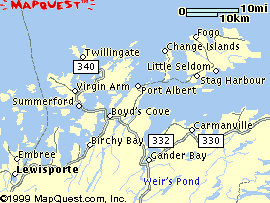
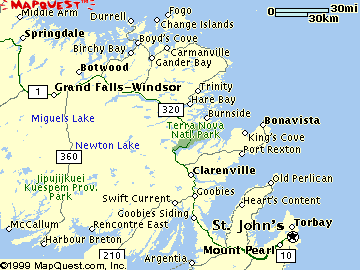
    Map one of area sailedThis didn't leave me much time to get ready. My clothes were still in the laundry from our visit to St. John's. I had to get to the bank and the stores, organize, and pack. It was a rush job, but we managed to pull away from the wharf at the Lewisporte marina around noon on Thursday. I was finally sailing.
    Peter Watkins and some guests were already out on the water aboard his Bayfield 32C, Paws II, so once we were clear of the harbour we got hold of them on the radio. Peter was pleased to learn that I had been able to make the trip. He invited us to join them for the night at Luke's Arm, a small community between Summerford and Bridgeport with a good harbour where he had relations and access to a good mooring. We wanted to make more distance than that on the first day, but after watching the fog move closer as we neared Cottle's Island, we decided it would be a good place for a boat without radar to spend the night.

    On the mooring at Lukes Arm
    View of the Watkins' wharf at Luke's Arm.
    You wouldn't think that Peter was such a common name, but on the two boats there were four people answering to it, and two more nearby on shore. Two of the boating Peter's were Newfoundlanders, while the other two were visiting from Ontario. All got along well, and it was a fun evening swinging safely on the mooring, sipping wine, eating cookies and muffins, and telling stories.

    We got up about 0700 the next day, and after a quick breakfast, set out to make up for lost time. The forecast, however, was calling for winds in the 40+ knots range to head our way, so we were watching the weather carefully, and always mindful of the closest safe port. The first one was Moreton's Harbour, and we wanted to visit with June and Carl Knight who run the marina there, but since the sailing was still good when we got to it, we carried on. By the time we got to Twillingate though, the picture was changing. It had become colder and rain was starting to fall. We decided it was time to look for a safe place to tie up and wait out the gale. We could hear Paws II calling on the VHF, but they couldn't copy us. I used the cell phone to let them know we were ok and what our plans were.

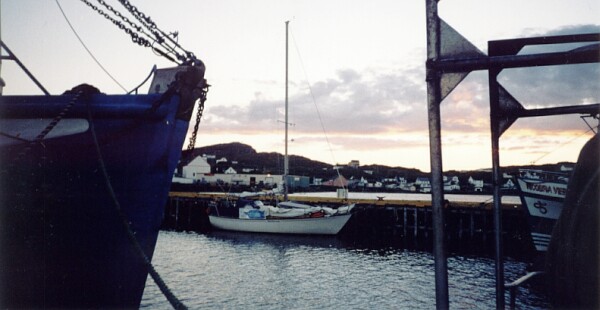
    Twillingate's fishplant wharf
    Windthrush docked at the fish plant's wharf in Twillingate as the sun sets.
    We tied up at the fish plant around noon. Among the many large, expensive fishing vessels there the 30' sailboat looked like a small tender. After getting some lunch we donned our rain gear and went for a walk around the community. My guess as to where town hall would be located was wrong, but at least it allowed us to extend the stretching of our legs. Eventually, we found it, and the skipper completed his ritual of collecting a town pin from each of the ports he stopped.

    The rain cleared up in the afternoon, but we stayed put to wait out the approaching storm. It struck while we were sleeping. Even though we were safely inside the 'U' of a sturdy wharf, and behind a breakwall, the winds that night shook the boat violently at times, rattling halyards and anything else that could make a noise. The undertow moved us forcefully from the extremes allowed by the spring lines, making at times for unexpected and abrupt stops that were almost enough to toss me out of my berth. I was glad we had 6 lines ashore when those jolts were strong enough to wake us at about 0200. We both got up and went into the cockpit to see what the instruments had to say about the wind speed and direction. The predictions were accurate, and then some in the bigger gusts. We saw speeds of force 9 on the Beaufort Scale. It was a restless night for both of us. I heard later that at Exploits Islands Paws II, and a few other boats, also had a rough night moored in that normally placid harbour.
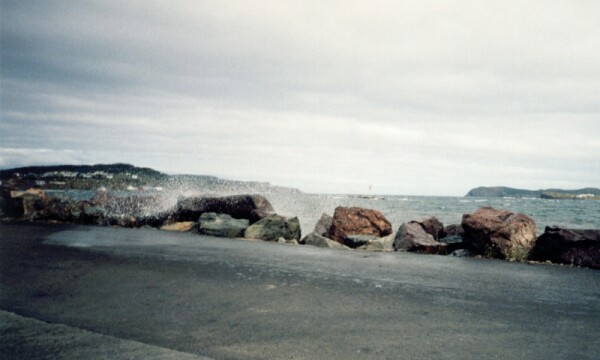
    Harbour still rough after the storm
    Spray coming over the wall at Twillingate
    The next morning, while the wind had dropped out to about 20 knots, still from the northwest, the waters had been whipped up into a large sea. The harbour scene alone was almost enough to prevent any sane individual from venturing onto the water. I guess that would explain the mental condition of the windsurfer we saw dashing back and forth while waves were still breaking over the sea wall. We waited until noon for things to settle a bit. Once certain that both we, and the boat, were ready for the conditions, the lines were cast off.

    There was not much room to maneuver, but the skipper decided it would be best to raise the main and jib in the somewhat protected waters behind the wall. The mainsail was no problem, but the jib decided to tangle a sheet and wrap itself around the forestay. After some quick turns, and close calls, we finally had the sails properly set and thus headed out to face what the gales had done to the cold North Atlantic.

    We sailed out of Twillingate harbour, and eventually found the buoys marking the east exit that the waves and swells were trying to hide. It was not a pleasant sail, but neither was it terribly uncomfortable. The boat carried itself well with a genoa and no reefs in the main, consistently making over 6 knots SOG. This was the case even when we cleared all the land protection and found ourselves out in 4 meter (12-15 foot) waves. While they were bigger than in the harbour, they were longer and in no way a threat to the boat. They were, unfortunately, a threat to my stomach.

    I have been prone to motion sickness for as long as I can remember. Growing up I always had to sit in the front seat of the car on highway tips. This time, however, I blamed the onset partially on my struggle with the sails in the harbour bringing me near exhaustion and dehydration. The good thing, is that I remain somewhat functional. We kept a bucket near and I tried to distract myself with different facets of boat operation. I was not wholly successful, but with only two of us aboard, I could not afford to get really sick. I survived, and after a couple hours of nausea, I adjusted to the conditions. This was, after all, my first sailboat trip in almost a year, and nearly 2.5 years since being out in similar seas (delivery of Paws II in June of 1998).

    While waiting in Twillingate, I had gone over the charts, setup some waypoints, and learned how to use the ship's GPS. When I went to Bonavista in 1997 aboard the Bayfield 36, Windborne III, we took the outside route, north of Fogo, away from all the rocks and other obstacles that boats don't like. This time, with better charts and information, we were going to try the Hamilton Sound route to save some time, and get some protection from those great big seas. Jim had been through there many times during his patrols with the Coast Guard, and had given us some pointers at that first meeting aboard Windthrush. It was also a better place to be with only two aboard in case there was any trouble.

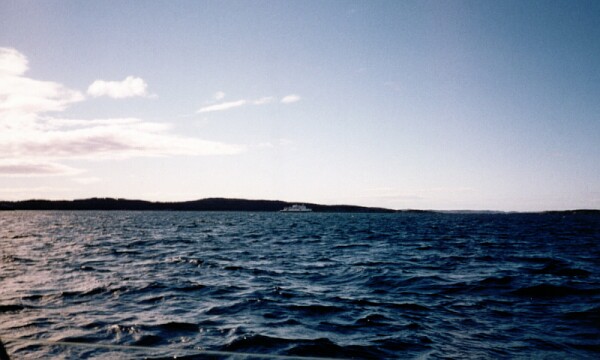
    The ferry departing Farewell
    The Fogo/Change Islands ferry
    We knew we could safely pass between Berry and Baccalao Islands. Once through, there was a range we would see behind us to help take the boat between some rocks, but we were well through, and doubting our source before it finally came into view. There are a lot of rocks in this region, and we could see them breaking all around us. Constant checks of the GPS (Peter was pleased with my waypoints and route), charts and landmarks made sure we made it safely through. We could see the Fogo/Change Islands ferry making her runs across our track as we progressed south to Steering Rock. We must have been a spectacle for several different groups of passengers. Since the cod fishery was open, we hove-to a couple times to see if we could catch a meal. Our luck only provided a single small tomcod which we carefully cooked underway on the small propane burner in the cockpit. Despite the bones, and the tiny portions, it was tasty.

    Map two of area sailedBy dark, the closest community was Musgrave Harbour. The sailing directions indicated we could find enough water for the boat's draft at the fish plant wharf, so this is where we decided to put in. Following the lights of the navigation buoys we made for the harbour. Seas were still around 2-3m, so we could see waves breaking too close for comfort. Once at the edge of the breakwall a tight starboard turn was required, but in the darkness doubt can creep in. We took our time, rechecked our path through the flashing reds and greens, and pressed on with fingers crossed. Arriving at the wharf we found no good place to tie up among all the fishing boats, so after checking with a local, we took the bay for the marine travel lift. With lines and fenders on both sides, we had a much more restful night than the one Friday at Twillingate.
    The next morning we were underway around 0930, with some advice from local fisherman on how to get through the rest of the sound, and perhaps where a cod could be found. Not only did we miss the rocks, but we also missed finding any cod. So much for another free meal (Peter was getting good at heaving-to though). Once past the protection of Fogo seas pickup up again, and once in a while some really big ones would pass under us. Eventually, we made a long tack offshore, almost half way to the Funk Islands, so that the next tack would take us clear of the rocks off Cape Freels. It was a good plan, but apparently the wind didn't like it. We were forced to motorsail in to our next planned port-of-call, Bonavista. While out there, however, something struck the boat. It was a solid thump, but not like hitting a log or other hard object. Our best guess is that it was a sleeping, or perhaps overly amorous whale. No damage was done, and if it was a whale, it was the second closest we came to seeing one along a stretch of water that is usually full of them. Our only sure sighting was one blowing in the distance near Comfort Cove, a couple hours out of Lewisporte. Unfortunately, we didn't see the actual whale.

    I had two possible rides available for Sunday to take me back home from St. John's, and an idea of how I could get out on Monday. Peter Watkins was going in for overnight, but didn't have room for me in his car. He would, however, if he took my mother's car. It was now Sunday evening and we were less than halfway to the city. My wife wanted me home by suppertime Monday, so it was time to make some decisions. The one we made was to keep going through the night, and carry on for as long as we could. So, in the darkness we bypassed Bonavista and Catalina, and made our way towards Baccalieu Island.

    I, being more of a night owl than a morning person, took the helm while the skipper took to his bunk. In the dark, with the clouds and stars overhead, the sound of the engine drowned out my singing. This was the time I enjoyed best during the trip. That is until around 0200 when a fishing boat, coming from the west side of the Bonavista Peninsula, decided to see if we knew the rules of the road or not. We were motorsailing, so they had the right of way, but we had kept the steaming light off since it severely hampered our night vision. As far as they should have been concerned, we were the stand on vessel. It took a couple of quick turns on our part to keep us from testing the strength of our fiberglass against theirs.

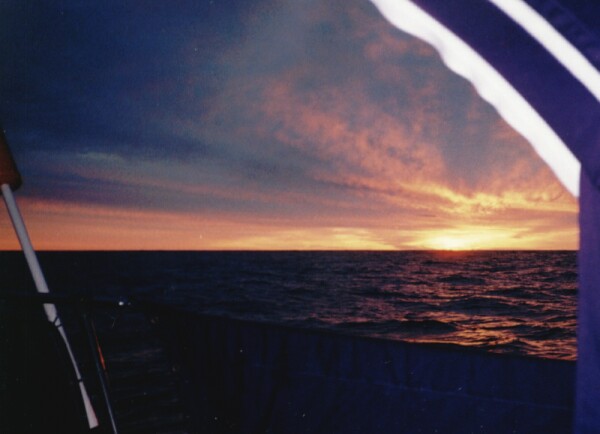
    Sunrise on the last day
    Sunrise off Trinity Bay
    While I tried to sleep, from 0300 to 0600, the skipper passed his 2000 nautical mile mark for the voyage since leaving Toronto. He even got some good sailing in to mark the occasion. I was awakened in time to witness the rising of the sun and the start to a beautiful day. Two hours into my shift, however, the wind had died and we were going backwards with the ebb current. It was time to haul down the jib and start the old Atomic gas engine. This woke up Peter, but he was able to get back to sleep again once underway, even though it was a bit noisier.

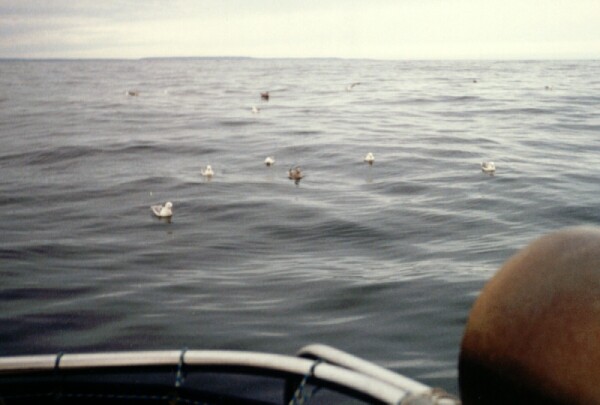
    While we were making the transition from sail to motor I noticed a lot of birds gathered
    Some hungry seabirds
    Sea birds waiting for some leftovers
    around our stern. It was not until later I realized they were probably waiting for some breakfast like they get from the fishing boats. We tried for cod several times along the way, but besides that one small tom cod, that was barely a mouthful for two hungry sailors, it was not to be. On Monday morning we gave it one last try next to a trawler hauling them up in a net. Still nothing. Since we didn't normally cook while underway due to the setup, meals consisted mostly of cold cereal for breakfast and sandwiches for other meals. This voyage would not be remembered for the quality of the cuisine. Most of the rest of the trip was uneventful. It was starting to get dark when we got to Cape St. Francis and passed by Pouch (pronounced pooch) Cove. By Torbay the lights of the towns became denser and brighter - we were nearing the city. Eventually, we could make out Cabot Tower lit up by flood lights on top of Signal Hill. We eased our way towards land until the two big green lights of the harbour range came into view. Entering St. John's at about 2300 was almost surreal. The cliffs seemed closer then they were, and the bottom of the harbour appeared to be downhill from us. Once inside the narrows a fishing boat passed by on her way out.

    As we floated in the center of the harbour taking down the sails, we heard Windthrush being called on the VHF. Having missed all three rides out, I had needed to make other arrangements for my trip home. Since gas in my car was about the same cost as the bus, my wife came in to pick me up. This gave her an opportunity for another quick visit with my mother, and also some control over when I got back home. Keeping her happy meant I might be allowed to embark on such an adventure again.
    Map one of area sailedIt had been the middle of that afternoon before the arrangements were made, and after a few hours of driving she was at the waterfront waiting for us, while we had traveled for five days and not yet tied up. She had contacted the harbour master to see if he had heard from us, so it was him calling to find out where we were. With some help from him we found a spot to dock right in the middle of the waterfront, beside a tour boat. A good place for Peter to be able to get around, see some sights, and take care of the few things he had to do.
    It was just as I was about to take my last look around the boat to see if I had everything when the only real mishap of the voyage took place. There is a good step down to a broad beam which runs the length of the waterfront against which the boats docked. There is a narrow gap between that and the wall. In the dark it made a perfect hole for me to fall into, hurting both knees and my right hand. (There is no outward sign of damage, but after a couple weeks my left knee still hurts.) We all said our goodbyes, and drove through the night to get home at about 0530. I had been awake for most of the past 48 hours.

    On the Thursday after I got home, I had two phone messages from Peter. One said his expected crew couldn't make it and he'd like me to come back to crew for the rest of the trip. A little while later there was another message saying that he had found some crew at St. John's, but might still like for me to join them, especially for the straight crossing. He managed to do it without me, however, and Windthrush and skipper made it safely to their new home in Nova Scotia about two weeks later. I am now more experienced and ready to embark on my next crewing adventure. Looks like this one is to the Bahamas!

    - Peter Haliburton 2000/10

       all displayed photos © Peter Haliburton 2000
     
    Trip Log Summary
    TIME LOCATION DISTANCE
    (LEG/TRIP)
    SPEED
    (LEG/TRIP)
    COMMENTS
    Thursday, August 31, 2000
    1200 Lewisporte - - Departed for St. John's
    1830 Luke's Arm 27/27 4.2/4.2 On mooring with Paws II
    Friday, September 1, 2000
    0800 Luke's Arm - - Departed
    1230 Twillingate 19/46 4.2/4.2 Docked at fish plant
    Saturday, September 2, 2000
    1130 Twillingate - - Departed
    2300 Musgrave Harbour 45/91 3.9/4.0 Tied up in travel lift bay
    Sunday, September 3, 2000
    0930 Musgrave Harbour - - Departed
    2359 Off Cape Bonavista - - Motorsailing through the night
    Monday, September 4, 2000
    0000 Off Cape Bonavista - - Motorsailing through the night
    2300 St. John's 159/250 4.2/4.2 Arrived at destination (60 hours)