2003-01-10

Sail Searching

The Quest For My First Sailboat
J. Peter Haliburton, © 2002-2003


Warm, yellow sun in a clear blue sky, cool breezes across glittering salt water, and the sound of waves rushing past the smooth hull of a fine sailboat. These are the images which caress the mind of a sailor. They are the things you can experience with good friends and family while out for the day, or weeks, of sailing. Ah, the joys of owning your own sailboat. But what if you don't have a wind powered vessel to call your own? This is where I find myself.

Most people, apparently, start out sailing as little kids using dingies. I was a bit of a late-comer, being 33 when first introduced to it. Sailboats were uncommon sights around the Lewisporte marina during my youth, with the vast majority of commercial and pleasure boats being of the hydrocarbon burning variety. I have a vague memory of being aboard the sailboat of some distant relative from the States sometime around, perhaps, age 12, but she was tied to a wharf and could have been any type of vessel for the impression left. No, it was not until June 16, 1997 I got to know the feeling of being on a vessel propelled across the water solely by the strength of the wind.

My first summer of sailing consisted of crewing aboard a beautiful Bayfield 36, plus a handful of brief excursions in a CL14. The Bayfield 36 owner traded down to a still lovely Bayfield 32 the next summer, and as more sailboats showed up at the local marina, I was able to sail on the Bay of Exploits aboard a variety of craft including an Aloha 8.2, a C&C 25, and a Tanzer 22. I had done several 6-8 hour voyages and a 6 day and night return trip outside my normal boating waters by the end of my second season. These experiences lead to more crewing opportunities, and my cruising and racing resume was growing quite nicely - until 2002: the year without sailing. Two invitations to crew for gulf crossings didn't work out, and with the high prices for fuel, my own power boat trips were very limited. It was a sad summer indeed. The solution? Get my own sailboat!

Ok, that is easily said, but how easy is it to do? During the fall of 2002 I pondered over the possibilities. There are a lot of different types, styles and sizes of sailboats. Phase 1 for narrowing down the list is budget. If I sold the speedboat for a reasonable price, and a few other things went my way, I should be able to swing $10,000 in total. Subtracting taxes and miscellaneous expenses, I arrived at a maximum boat cost of about $7500. It was obvious at those numbers I wasn't going to be able to purchase even a 25 foot Bayfield, my preferred make, but there are some quite nice boats in the pocket cruiser range. Phase 2 was finding the affordable boats which meet my requirements: trailerable, fin keel cruisers with a semi-private head, able to maintain reasonable speeds while not sending me looking for cover when the winds get above 25 knots, and room and amenities for four people on a week's sailing holiday. I don't ask for much.

My first candidate was the Thunderbird 26. This would likely give me the largest boat for the least amount of money. They are fast, safe, and popular. The trade-offs are an old design, little interior space, and unknown construction quality since they were mostly homemade. The latter gave me the most cause for concern, so I went looking for a boat in which consistent quality wouldn't be an issue. The Shark 24 had all the benefits, with the added assurance of reputable Canadian manufacturers having put them together. The interior space, however, might be a problem here as well. While I may be single-handed quite often, I would likely often have 4 or 5 people aboard for a full day on the water. They wouldn't want to be crushed together in the cabin if the weather turned bad, or if we decided to make a weekend, or much longer, trip of it. Racing ability is not a priority, so perhaps a little more comfort might be had with a little more looking.

Canadian firms were very busy in the 1970's and 80's pumping out some great little sailboats. At about 22 feet there seemed to be a sweet spot for comfort, safety, trailerability and price. Popular boats in this class include the Abbott 22, Tanzer 22, V&G Sirius 21/22, and CS 22. I looked over the specs for these (see Table 1), and similar boats, and was leaning a bit towards the Abbott. I'd had a brief sail aboard one in 2001, and was impressed. Then I stumbled across a boat with somewhat of a local connection. The Grampian G23 was designed by Alex McGruer, a transplanted Scot who eventually wound up living in Newfoundland. I had even exchanged a couple emails with his son concerning sea kayaking. Perhaps this boat was the best compromise, with just a pinch of fate.

Designed around 1967, the G23 has a slightly retro look, but not as dated as the Shark or Thunderbird. The cockpit is somewhat small, but that means more space is devoted to the cabin. This is the opposite of the Tanzer 22, which suffers from a severe lack of interior room in favour of a huge cockpit. The Grampian also has 14" of additional width, and almost double the ballast of the longer Shark which should make it stiffer and offer more comfort in rough seas. With most boats in this size range you are lucky to have a porta-potti located under a cut-out in the forward berth, but a fairly private head is another thing the G23 has in its favour. The pop-top is an option often found often on the popular swing-keel CS 22 and Sirius 21/22. On the G23 it increases headroom from a very reasonable 5' 4" to a vaulting 6'. With an icebox, 2 burner stove and small sink, and sleeping accommodations for 5 people, weekend or longer voyages could be easily undertaken. They can also be found listed for under $5000, and even the most well outfitted is normally priced under $8000. Eureka! I had found my boat. Or had I?

There were still a couple more sailboats waiting to be considered. The Nova Scotia built Paceship PY23 also met most of my requirements, but they do tend to be a bit more expensive, being closer to $10,000. At that price I could get into the well praised and roomy Grampian 26. Another sailboat which had good numbers is the Tanzer 22-like Sonic 23. It also seemed to be a bit pricey, and the head is located under the v-berth, so it places nearer the bottom of my list.


Now that I have pretty much decided on which sailboats best fit my needs and budget, I have the winter to scour the marketplace in search of the best ones. My personal rankings place the potential boats in the following order: Grampian 23, Abbott 22, Shark 24, Paceship PY23, Sonic 23, and Tanzer 22. The spring will involve some travelling to see them in person and do some test sails. And, if all goes well, sometime in July I will be bringing home a sailboat to call my own. In the meantime, anyone looking for crew?


Table 1:


Thunderbird Shark 24 Grampian 23 Sonic 23 Paceship 23 Tanzer 22 Abbott 22 CS 22 Sirius 21/22
Length on Deck (ft): 25.979 24.000 23.250 23.000 22.583 22.500 22.000 21.667 21.167
Length at Waterline (ft): 20.250 20.000 20.917 20.000 19.417 19.750 18.750 17.500 18.750
Beam (ft): 7.542 6.833 8.000 7.583 8.000 7.833 7.500 8.000 7.917
Sail Area (sq. ft): 308.00 190.00 244.00 240.00 223.00 222.00 226.00 250.00 203.00
Ballast (lbs): 1,534.00 675.00 1,150.00 1,500.00 945.00 1,250.00 1,550.00 1,100.00 525.00
Displacement (lbs): 3,650.00 2,200.00 3,200.00 3,400.00 2,460.00 2,900.00 3,100.00 2,200.00 2,000.00
Draft (ft): 4.79 3.17 3.08 3.75 3.50 3.42 3.83 5.00 5.00
Hull Draft - not keel (ft): 1.16 0.94 1.00 1.00 1.30 1.08 1.35 0.87 0.82
Headroom/Pop-Top (ft): Sitting Sitting 5.17/6.0 Sitting/6.08 5.0 4.5 5.08 4.42/?? 4.75/??
Hull Speed: 6.030 5.993 6.129 5.993 5.905 5.955 5.802 5.606 5.802
Capsize Screen: 1.961 2.104 2.174 2.019 2.373 2.199 2.060 2.463 2.516
Lbs/Inch Immersion (PPI): 537.560 481.013 588.986 533.810 546.749 544.516 494.969 492.769 522.489
Disp.-Length Ratio: 196.232 122.768 156.100 189.732 150.017 168.054 209.947 183.257 135.450
Sail Area-Disp. Ratio: 20.831 18.009 18.016 17.018 19.620 17.503 17.043 23.696 20.504
Motion Comfort Ratio: 16.211 11.568 13.398 15.800 10.920 13.113 15.482 10.592 9.421
Ballast-Disp. Ratio: 0.420 0.307 0.359 0.441 0.384 0.431 0.500 0.500 0.263
Beam-Length Ratio: 0.290 0.285 0.344 0.330 0.354 0.348 0.341 0.369 0.374
Screening Stability Value: 30.312 49.789 48.340 34.671 37.974 36.970 22.861 45.511 92.447
Angle of Vanishing Stability: 129.693 120.053 120.433 126.213 124.299 124.831 141.102 121.264 114.852
2/1000 Rule-Of-Thumb HP: 7.3 4.4 6.4 6.8 4.9 5.8 6.2 4.4 4.0
Minimum Suggested HP: 5.9 3.5 5.3 5.4 3.8 4.6 4.6 3.1 3.0

Figures may vary from boat to boat, and some are estimated or scaled from drawings. This chart represents best efforts to obtain accurate data, but there may be errors.
------------------------------------------

For more information and to check my facts see:
http://www.geocities.com/grampianowners/g23.html
http://forums.delphiforums.com/Grampian
http://members.sailnet.com/email_lists/processing/index.cfm?list=grampian
http://members.attcanada.ca/~jamelia/grampian.htm
http://www.telusplanet.net/public/bgschu/webdoc2.htm
http://www.pyacht.com/Rig%20Data%20-%20G.htm
http://sailquest.com/market/models/
http://www.thunderbirdsailing.org/
http://www.shark24.org
http://www.canyacht.com/onlineExclusives.php
http://boatcrew.w3site.com


Last revised: 2003/01/10

2001-10-31

My Early Sailing Resume


J. Peter Haliburton
~ Boating Resume ~


SAILING LOG BOOK SUMMARY *
1997 SEASON
Date Make and Model Vessel Skipper/Owner Duration
Activities Aboard Distance
June 16 1985 Bayfield 36 Windborne III Peter Watkins 7 hours
Acted as crew for delivery to Lewisporte from Triton. 38 miles
June 21/22 1985 Bayfield 36 Windborne III Peter Watkins 32 hours
Crew and GPS navigator during an overnight trip to Bonavista. 175 miles
June 25/27 1985 Bayfield 36 Windborne III Peter Watkins 30 hours
Crew and GPS navigator during the two night return trip to Lewisporte. 175 miles
July 9 1985 Bayfield 36 Windborne III Peter Watkins 10 hours
Crewed during a return day trip to Exploits Islands w/ whale watching. 40 miles
July 22 1985 Bayfield 36 Windborne III Peter Watkins 12 hours
Crewed during a return day trip to Exploits Islands. 50 miles
July 25 1985 Bayfield 36 Windborne III Peter Watkins 4 hours
Crewed during an afternoon cruise. 20 miles
July 28 1985 Bayfield 36 Windborne III Peter Watkins 4 hours
Crewed during an afternoon cruise. 20 miles
unknown 1985 Bayfield 36 Windborne III Peter Watkins 8 hours
Crewed during a return day trip to Exploits Islands. 40 miles
unknown 1985 Bayfield 36 Windborne III Peter Watkins 8 hours
Crewed during a return day trip to Exploits Islands to pick up some passengers. 40 miles
unknown 1985 Bayfield 36 Windborne III Peter Watkins 10 hours
Lewisporte to Lukes Arm to Samsons Is, anchored overnight then back. 50 miles
unknown 1985 Bayfield 36 Windborne III Peter Watkins 8 hours
Crewed during a return day trip to Exploits Islands. 40 miles
unknown 1985 Bayfield 36 Windborne III Peter Watkins 8 hours
Lewisporte to Lukes Arm to Samsons Is to anchor overnight then back. 50 miles
October 5/6 1985 Bayfield 36 Windborne III Peter Watkins 10 hours
CYA Intermediate trip (Triton with overnight anchored at Exploits Is). 38 miles

1998 SEASON
Date Make and Model Vessel Skipper/Owner Duration
Activities Aboard Distance
June 8 1988 Bayfield 32C Paws II Peter Watkins 8 hours
Co-delivered boat from Triton to Lewisporte. 38 miles
June ?? 1988 Bayfield 32C Paws II Peter Watkins 3 hours
Anchored out at W Hr Sivier I for dinner. 15 miles
July 18 1988 Bayfield 32C Paws II Peter Watkins 9 hours
Crewed during a return day trip to Exploits Islands. 40 miles
July 25/26 Aloha 8.2 Jo-Lain Wayne Wall 10 hours
Pilot as part of a flotilla to Lukes Arm and back w/stopover at Comfort Cv. 50 miles
Aug 3 Aloha 8.2 Jo-Lain Wayne Wall 4 hours
Piloted boat from Lewisporte to Exploits as part of a long weekend trip. 20 miles
Aug 4 Aloha 8.2 Jo-Lain Wayne Wall 6 hours
Piloted boat from Exploits to Moretons Hr and back. 25 miles
Aug 5 Aloha 8.2 Jo-Lain Wayne Wall 1 hours
Piloted boat from Exploits to Swan Island. 5 miles
Aug 5 1977 Tanzer 22 Sunrise Princess Ralph Miller 1 hours
Piloted boat from Swan I to Exploits. 5 miles
Aug 6 Aloha 8.2 Jo-Lain Wayne Wall 4 hours
Crewed on return from Exploits to Lewisporte. 20 miles

1999 SEASON
Date Make and Model Vessel Skipper/Owner Duration
Activities Aboard Distance
May 15 1984 C&C 25 Buckshee Blaine Duff 2 hours
Spring shakedown cruise and trial of new spinnaker. 8 miles
May 17 1984 C&C 25 Buckshee Blaine Duff 6 hours
Out to Ochre Pit I. to see a huge grounded iceberg. 30 miles
May 20 1984 C&C 25 Buckshee Blaine Duff 2 hours
A fun afternoon harbour cruise in about 25kts. 8 miles
June 23 1984 C&C 25 Buckshee Blaine Duff 7 hours
Lewisporte to Botwood for Wednesday evening race. 35 miles
May 24 1984 C&C 25 Buckshee Blaine Duff 8 hours
Ran from Botwood to Exploits to Lewisporte. 40 miles
unknown 1984 C&C 25 Buckshee Blaine Duff 7 hours
Lewisporte to Botwood for a race. 35 miles
unknown 1984 C&C 25 Buckshee Blaine Duff 7 hours
Returned from Botwood to Lewisporte. 35 miles
Unknown 1977 Tanzer 22 Sunrise Princess Ralph Miller 3 hours
Afternoon harbour cruise. 15 miles
Aug ?? 1984 C&C 25 Buckshee Blaine Duff 2 hours
Singled-handed afternoon harbour sail. 10 miles
Sept 8 1984 C&C 25 Buckshee Blaine Duff 2 hours
Skippered for an afternoon harbour sail. 10 miles
unknown 1984 C&C 25 Buckshee Blaine Duff 6 hours
Lewisporte to Botwood for Grassy I. race, saw whales. 35 miles
Sept ?? 1984 C&C 25 Buckshee Blaine Duff 1 hours
Skippered for an afternoon harbour sail. 5 miles
Oct 3 1984 C&C 25 Buckshee Blaine Duff 2 hours
Skippered for an afternoon harbour sail. 10 miles

2000 SEASON
Date Make and Model Vessel Skipper/Owner Duration
Activities Aboard Distance
Aug 31
to Sept 4
1974 C&C 30 Windthrush Peter Briffa 60 hours
Crew and co-navigator during a trip to St. John's, including one overnight (38 hrs). 250 miles

Nov 13
to Nov 24
1984 Bayfield 32 Salt Heart Bill McMaster 82 hours
Crew and co-navigator Charlottetown, PE to Shelburne, NS. 8-12 watch. 415 miles

2001 SEASON
Date Make and Model Vessel Skipper/Owner Duration
Activities Aboard Distance
June 22 Abbott 22 Mark 10:31 Peter Watkins 2 hours
Crew for an afternoon harbour sail. 8 miles

Jul 29
to Aug 1
1984 CS 30 Careless Whisper Julie and Edward Rideout 50 hours
Crew and co-navigator Lewisporte, NF to RNYC 225 miles


* Sailing experience only, power boating was not logged. Where exact dates were not known, the order should be correct. Four times sailing a CL-14 on both salt and fresh water were not logged. Numerous trips helping with sailing lessons were not logged. Some distances and times may be rounded off.


This page was last updated on 2001/10/31.

2001-08-05

A Whale of a Time Aboard Careless Whisper (2001)


  Originally written in 2001

A Whale of a Time Aboard Careless Whisper
(July 29 to August 1, 2001)


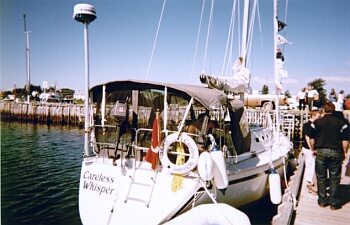
Careless Whisper at the Lewisporte marina
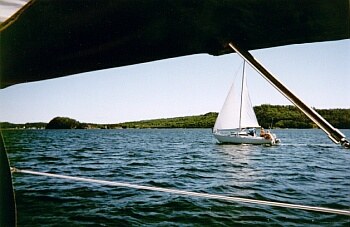
Mark 10:31 to our starboard
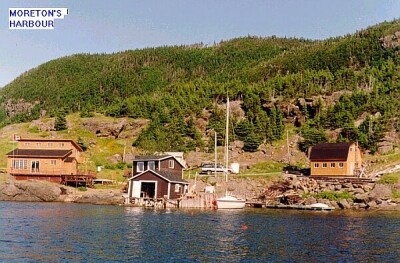
Moreton's Harbour Marina
Careless Whisper safe at Musgrave Harbour
Edward checking over the boat after docking
Edward checking the boat after docking
Snugged down at Catalina
Docked at Catalina
Finally getting in some sailing
Getting in some sailing
Sailing across Conception Bay
Nearing Bell Island
Bell Island
Arrival at the RNYC marina
At the RNYC marina
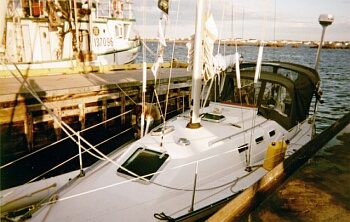
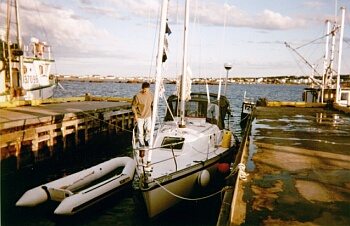
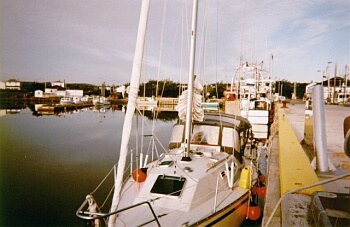
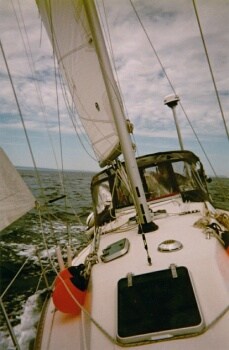
The sailing vessel Careless Whisper is a very nice 1985 CS 30. She is was well outfitted with electronic gear, and a comfortable vessel for coastal cruising. Her owners, Julie and Edward, while relatively new to sailing, are quite capable. They had just returned to Lewisporte following their participation in a small week-long local flotilla, and wanted an extra hand to help get the boat back to their home port at the Royal Newfoundland Yacht Club marina. My sailing and navigation skills would only be a back-up to theirs in case the weather turned bad, or some emergency arose.

Sunday, July 29: By the time we loaded up, and said our good-byes, it was 1100 when we cast off the dock lines and got underway. Winds were forecasted to be an ideal Westerly 15 to 20 knots, but never actually got much over 10, so we had to motor off and on. An Abbott 22, Mark 10:31, containing our friends Carolyn, Peter and Clara accompanied us part-way across Embree, but soon slipped behind, so we bid them farewell over the radio. Also on the VHF was Just Carrying On who, along with Meagan Rae, was returning to Lewisporte from our destination, Moreton's Harbour. We arrived at the private marina there at about 1700, having only enjoyed a couple short sails. We did, however, see some whales off Western Head as we passed inside Gull Island; foreshadowing the rest of the trip.

Monday, July 30: I had my alarm set for 0600, but woke up at 0530. While waiting for the others to rise I went outside to inspect the day. It was very calm, but a light breeze was rustling the flags by the time we departed at 0730. About half way to Twillingate a whale surface a couple meters in front of the boat. This, however, was just the first one of the day, and the many we would see while motorsailing through Notre Dame Bay. We took a different route than I had gone on previous voyages, going between Change Islands and Fogo. I was looking forward to this section, but had a nap in my aft berth after lunch and missed it. I am not normally a morning person, and rarely do I nap, but early mornings and long days on the water can be tiring. The plan was to put in at Seldom for the night, but with lots of daylight left, we decided to see if we could make Lumsden. Plagued still by the light and fickle winds, we did not cover as much distance as we hoped, and decided to pull into Musgrave Harbour. It was a much nicer arrival than the last time I sailed into the community (aboard Windthrush). The same dock space was available, and that evening we tuned up the rigging which had slackened slightly with all the sailing Julie and Edward had done that summer.

Tuesday, July 31: Once again I awoke at 0530, and got dressed before my hosts in the forward berth. Departure took place around 0700. We were greeted once again by familiar light winds, although they were variable from the North and a little cool for the time of year. While motorsailing, we attempted to keep our SOG at 6 knots and managed to average a very reasonable 5.7. Our port of call for the evening was Bonavista, but once more ahead of schedule, and experiencing reasonable weather, we carried on to Catalina, passing close aboard the only cardinal buoy I have seen in Newfoundland waters. (We saw it flashing at night from Windthrush, but couldn't find it in the list of lights at that time.) The day was again filled with whales and even some close encounters off Cape Freels. One was continuously slapping its tail on the water all the while we were approaching the entrance to Catalina. This was new, yet unexplained behaviour to me. I had been wearing my sunglasses all day and forgot to take them off, so I was experiencing more darkness than there actually was. I am using the adjustment my eyes had to make as an excuse for not finding the range, since I am normally known for my keen eyesight. After making the twists and turns to make our way into the harbour, we found that the kind people of Catalina had a new wharf constructed just for us, or so I would like to think. You could still smell the paint on the wood, but the power, unfortunately, was not yet looked up.

Wednesday, August 1: Departure took place at 0700. This day the light winds were mixed with some fog, and that gave Julie an opportunity to more seriously practice her navigation since we may have to go long distances without being able to see any landmarks, or much of anything for that matter. She planned us a safe route to the marina and carefully entered it into the GPS. Along with the radar, we were well prepared to handle the reduced visibility with safety and confidence. As it turned out, we didn't really need the electronic gadgets. The fog cleared well before we had to make our way Between Grate's Point and Bacalau Island. While we were making our way through the channel, we noticed two other sailboats. They were hugging the cliffs and seemed to be gaining on us. If we abandoned our safe track and kept closer to shore ourselves, we could shave a little time off our voyage, so that is what we did. This worked out well, except for the obsticle course of many net buoys I had to weave through on the East end of the channel. Getting just an hour or so away from the marina, the wind decided to picked up and help speed us on our way. The sun was also out by this point too, and the last part of the trip became the most enjoyable. Just outside the channel to the marina we dropped sail and motored in while several other sailboats were heading out for their normal Wednesday evening races.
The voyage was marked by many whale sightings (Which are hard to get good picture of with a disposable camera and no zoom!) and light winds, but the most memorable part was the generosity and kindness of the boat owners. They took very good care of me, and saw that I was not out of pocket myself as long as I was with them. I wish Julie and Edward all the best, and as with most people I have sailed with, hope I can go boating with them again sometime.

- Peter Haliburton © 2002
   All displayed photos, except Moreton's Hr. Marina, © Peter Haliburton 2001


Trip Log Summary
TIME LOCATION DISTANCE
(LEG/TRIP)
SPEED
(LEG/TRIP)
COMMENTS
Sunday, July 29, 2001
1100 Lewisporte - - Departed the LYC marina for Moreton's Harbour
1700 Moreton's Harbour 27.2/27.2 4.7/4.7 Arrived at the marina
Monday, July 30, 2001
0730 Moreton's Harbour - - Departed
1830 Musgrave Harbour 54.9/82.1 4.8/4.7 Arrived
Tuesday, July 31, 2001
0700 Musgrave Harbour - - Departed
2115 Catalina 80.9/163.0 5.7/5.1 Arrived
Wednesday, August 1, 2001
0700 Catalina - - Departed
1930 RNYC Marina 62/225 5.0/5.1 Secure at destination

2001-03-04

Boating Background


J. Peter Haliburton
~ Boating Resume ~
NARRATIVE

Wells' Point, Exploits Islands, NFGrowing up in the coastal community of Lewisporte, NF, I spent much of my life on the water. I remember going out to Exploits Islands, at the mouth of the Bay of Exploits, in my grandfather's boat while quite young. The trip would take three to four hours, not counting the stop for a lunch, to cover the roughly 18 nautical miles. In my early teens my father got our first boat. It was a 19' cuddy speedboat with a 135hp Johnson outboard for power. Exploits could be reached in a little over 30 minutes in that rocket. The same boat is still making that trip, now with its third owner, after more than 20 years. The engine has been replaced with a larger one though, and it is even faster. 

Our present boat ready to head out to Exploits (1999)Our next vessel was a Trojan cabin cruiser. It was nice, but expensive to operate and maintain. It was in turn sold in favour of an older cabin cruiser with a diesel engine. That boat was traded on a couple of old wooden boats belonging to my uncle. Those didn't even make it into the water. There was a fiberglass speedboat for a short period of time, but my siblings and I were all long gone by then, and my parents rarely went boating during that period. So, eventually, there was no boat at all, and my grandparent's old house at Exploits began its descent into a sorry state of disrepair. 


Exploits had always been our destination. Since it is a pair of islands, a boat was the means of getting there. We rarely went elsewhere. We passed by the other islands so quickly we hardly noticed they were there. The wildlife and other sights were just a blur. The boat ride was fun, but just a means to an end.
Parker and I in the current boatMy family and I moved back to Lewisporte in the late summer of 1994 after many years away. In the spring of 1996 we got our first boat to facilitate the repair of the old Wells family home out on the island. It is a modified Bayrider, 19' open speedboat with a 70hp Mercury outboard. On a good day, with a light load, it can make Exploits in as little as 40 minutes, but usually the trip takes about 50 minutes. This boat serves as a means to transport material for the repair and upkeep of the house my grandfather built at Exploits. Enjoyment of the trip is short and somewhat limited. 


Peter Watkins' Bayfield 36 in 1996During the winter of 1996/1997 I got to know Peter Watkins. He had grown up in the area, but had spent most of his working life in Ontario. He was a recreational sailor who had spent years sailing on Lake Ontario and the BVIs, crossed the Atlantic once, taught sailing, and was a great promoter of sailing. On June 16, 1997 I got my first trip on a sailboat when we brought his Bayfield 36, Windborne III, over to Lewisporte from the Triton shipyard where it had spent the winter. 


This was when I learned that the joy is in the journey, not just the destination, and that a sailboat is the vehicle to do it in. Even my wife, who is normally afraid of the water, and disliked boats in general, enjoyed being on his sailboat. There was something very different about this mode of transportation.
LACC signJuly of that year a flotilla of boats from Ontario and beyond made their way down to Bonavista, NF for the arrival of the Matthew. This was all in celebration of the 500 years since the discovery of Newfoundland by John Cabot. (The Vikings had preceded him by another half millenium, but that celebration is in the year 2000.) When the Central Newfoundland chambers of commerce chartered Peter's boat for the trip from Lewisporte to Bonavista to be a part of this, I was the navigator and second in command. This was a fantastic experience. 


Peter Watkins and I in the CL14 on Woolfrey's PondDuring the summer of 1997 I had the opportunity to sail Peter's CL14. I had this fun little dinghy on the pond at the end of our street, and in Lewisporte harbour. The third boat he brought down from Ontario was an Abbott 22, but I didn't even get to see this one since it was sold the previous summer, and wound up back in Ontario. The CL14 was sold locally in 1997. Things had not gone quite as Peter expected. 


Windborne returning from Exploits (1997)Windborne III was used for charters and sailing lessons. I helped out with those whenever I was able to, and while onboard, I got to do my basic sailing course as well. The cruises often involved day trips to Exploits where the guests usually had lunch at Devon House before returning to Lewisporte. When not out on business, we enjoyed day trips all over the Bay of Exploits. Life was good. In October we sailed her back to Triton as part of our intermediate training. 


1998 offered a large variety of boating experiences. In that year Peter Watkins and I designed our own basic coastal navigation course and put off our first class. We had a great time with the bunch of students we had in Musgravetown. They all did very well. This was when Peter was stricken with a serious illness and closed his business. We had to postpone the second weekend of the class for much longer than expected, but he was able to complete it, and planned another class closer to home for the fall. 


Peter Watkins' Bayfield 32 at the Lewisporte Marina with the skipper on the bowEarlier in the fall he had traded down from the Bayfield 36 to a Bayfield 32, Paws II. The swap took place at the Triton yard on a cold wet day in April. I got my first experience rigging on this boat, and delivered it, along with another fellow, to Lewisporte on June 8. That was a mean 7.5 hour trip. There was fog, lots of icebergs, and 8' to 10' seas. On Windborne there was a radar to help get through the fog, but on this trip we were lucky it never got thick enough for us to lose sight of the shore, or the ice, for very long. 


Lewisporte marina complex in 1998With the expansion to Lewisporte's marina in 1998 the number of sailboats increased. Two of the boats were owned by first-time sailors, so I got to help in the rigging of a C&C 25 and an Aloha 8.2, as well, I was involved with the tune-up a Newport 30's rig. I was also very active in the launch of the C&C 25. 


On July 25 I was aboard the Aloha 8.2 on a trip with three of the boats to Luke's Arm, with a stop-over in Comfort Cove. I was acting as advisor and crew for the owner on one of his first trips of any distance. Later, on August 3, I travelled on the same boat as guide for a trip it, and a Tanzer 22, made to Exploits Islands, Moreton's Harbour, and Swan Island. My mother had her first trip on a sailboat during this time. I sailed on the T22 going from Swan Island to Exploits. 


Me at the helm of Windborne in 1997There was not much time for sailing after that as I had to concentrate on getting some work done on the cabin before winter. For the rest of the summer and fall, boating was restricted to my own boat.
In January 1999, Peter Watkins and I put off our second basic coastal navigation course. This one was held in Lewisporte, but the students came from all over central Newfoundland. Again we had a great bunch of people who did very well. Doing these classes has been more like a social gathering than being in school, and that seems to help our older students. 


The Rachel sail/motor/row dinghyOn April 7th the plans to build a great little dinghy arrived. I am continuing to learn the skill necessary to complete its construction, and to track down all the required materials. I hope to have Rachel in the water before July. 


Due to exceptional spring weather, work on all the sailboats was able to commence in mid-April. Thus, the launch of the 4 sailboats requiring a crane is scheduled for Saturday, May 8. This is about a month earlier than normal. I was planning on a day trip to Exploits to check on the the cabin, but with pack ice still haunting the bay, my helping with getting the sailboats in the water looks more likely.
I hope to be able to do some racing with Blaine Duff on the C&C 25 the summer of 1999. Having spent two summers learning to sail, and just cruising around, I am ready to try something new. His is a fast boat and I hope we can do well with it. 


That took us up to the spring of 1999, and it is now the winter of 2000. This is a good time to reflect on the past season. As these memories are fresher than the ones covered previously, I will go into a little more detail on the various events.
The Rachel is still not started. There wasn't room in the budget for the $500-$800 cost to build it. Somewhere down the road I will construct and sail her though. She is a good boat for my son to use and learn on.
Buckshee heading off to race at BotwoodIt was the first summer I did not get to sail with Peter and Carolyn since my introduction to sailing. Schedules and other matters kept us from being on the water together. In fact, other than an afternoon sail aboard Ralph Miller's Tanzer 22, I had all my trips on the C&C Buckshee. 


Blaine, her owner, had only gotten into sailing the summer before I did. He was one of at least three groups of people who went on a cruise with Captain Watkins and had a boat of their own not too long after. This was also the case with Leslie and Wayne Wall and their Aloha 8.2, and the Barrett's Bayfield 25. The Peytons are still looking for their perfect boat. 


On May 15, 1999 I was giving Blaine a hand with a few things on his boat. The winds were light, maybe 5 knots, so we decided it would be a good time to try his new asymmetrical spinnaker. I had helped fly one one a couple years previous on Windborne, and there was an instruction manual, so with a word of warning from Peter to tape up everything that couls cause a rip, off we went. We managed to figure out how to run all the lines, and the trial run was successful. Now we were ready for those light wind races in Botwood. 


The iceberg aground off Ochre PitMy second trip on Buckshee was on the 17th. I thought we were just going to give the boat a short run around the harbour, and was only prepared for that. After we got so far out, however, we saw a huge iceberg aground off Ochre Pit Island, so we had to go take a closer look at it. I was about 3 hours overdue getting home, but it was worth it for the grand sights and the great sailing. 


On June 24th, following the weekly Wednesday race in Botwood, Blaine and I decided to run out to Exploits before heading back to Lewisporte. The winds were light, so we had to motor most of the way, but it was a wonderful warm and sunny day. Here and there we could see the remnants of icebergs aground in a cove, or drifting aimlessly about the bay. 


C&C25, Aloha 8.2 and Bayfield 32 at Luke's Arm (1998)Racing aboard Buckshee was more work than I expected it would be. With just the two of us relatively inexperienced sailors against a field of seasoned vets, it was a wonder we did as well as we did. Blaine did most of the helm work, so I was rushing around the decks, trimmed the sails, checked the charts and GPS, cooked the meals, and generally beating myself out and up. I can now relate to the happenings as I watch the America's Cup races. 


In August, on a sunny afternoon with about 10 knots of wind I took Buckshee out myself for my first single-handed sail since 1997 in the CL14. Being alone on a boat is oddly relaxing, even though you need 6 arms and to be in several places at once. I had made a couple runs in my speedboat by myself, but when sailing you become one with your environment. You, the boat, the water and the wind all working together. For a while I was able to balance the sails, tie off the tiller, and ride on the bow. I look forward to the day when I can have a sailboat of my own, of any size. 


Leslie, Wayne, Roxanne and I aboard Jo-Lain (1998)Other than an enjoyable, and that expected afternoon with Ralph on his T22, much of my summer was spent on a boat with someone I didn't really know that well, and never socialized much with away from the docks. It is even more interesting that my last four sails on his boat where done without Blaine aboard. These were my first opportunities to truly skipper a sailboat, not just look after one while the skipper was napping, or otherwise occupied. It is good to have someone trust you enough to give you the keys to their boat and permission to use it within the harbour pretty much at whim. 


My wife, Roxanne, and son, Parker, got their only sail of the season on October 3rd. This was also my last sail of the season, but I did get out in my boat again. Next summer could be very different again. The Aloha was sold in the spring, and was been relocated. leslie and Wayne are still missed by their fellow sailors. The owner of a Tanzer 26 I was hoping to get out on has moved, and his boat up for sale. And, just recently, I found out that Blaine has been transfered and his boat is up for sale (sold winter 2000). 


FRIENDS: Carolyn, Peter and Roxanne at Samsons Island in 1998So far in 2000 I have had just the one sail, but it was a good one. For details click here. In November 2000 I embark on my first real offshore and international delivery/crewing experience. I'll be helping bring a Bayfield 32 down to the Bahamas for the owner's winter escape. This is the next logical step for me, and my first time out of the country. I'll be looking for other crewing opportunities while I'm down there. If you know of anyone needing crew there around the end of November, let me know, or let them know about me. 


To date, I have accumulated over 300 hours of sailing time
and about 1500 nautical miles traveled.


This page was written on 1999/05/05 and last updated on 2001/03/04.

2001-01-26

Marine Industry Careers

INTRODUCTION

I have been researching the life of a professional seafarer to see if this is indeed the career route I now wish to follow. Since others might also find this information useful, I'm putting a summary of what I compile online. I'll develop this page further as I learn more about the wide and various positions available to the professional mariner.

DEFINITIONS

Captain (Master, Skipper): The person in overall command of the operation of a vessel. They supervise the work of the other officers and the crew. They set course and speed, maneuver the vessel to avoid hazards and other ships, and periodically determine its position using navigation aids, celestial observations, and charts. They direct crew members who steer the vessel, operate engines, signal to other vessels, perform maintenance and handle lines, or operate towing or dredging gear. Captains insure that proper procedures and safety practices are followed, check that machinery and equipment are in good working order, and oversee the loading and unloading of cargo or passengers. They also maintain logs and other records of ships' movements and cargo carried.

Deck Officers (Bridge Officers, Mates): Assistants to the captain. Merchant marine vessels - those carrying cargo overseas - have a chief or first mate, a second mate, and a third mate. Mates oversee the operation of the vessel, or "stand watch" for specified periods, usually 4 hours on and 8 off. On smaller vessels, there may be only one mate (called a pilot on some inland vessels) who alternates watches with the captain.

Deckhands (Seamen): Operate the vessel and its deck equipment under the direction of the ship's officers, and keep the non-engineering areas in good condition. They stand watch, looking out for other vessels, obstructions in the ship's path, and aids to navigation. They also steer the ship, measure water depth in shallow water, and maintain and operate deck equipment such as life boats, anchors, and cargo-handling gear. When docking or departing, they handle lines. They also perform maintenance chores such as repairing lines, chipping rust, and painting and cleaning decks and other areas. Seamen may also load and unload cargo. On vessels handling liquid cargo, they hook up hoses, operate pumps, and clean tanks. Deckhands on tugboats or tow vessels tie barges together into tow units, inspect them periodically, and break them apart when the destination is reached. Larger vessels have a boatswain (bosun) or head seaman.

Purser: The main purpose of the purser is to see to the comfort of the passengers. This position would only be found on cruise ships, ferries or similar vessels transporting paying passengers.

Engineers: They operate, maintain, and repair propulsion engines, boilers, generators, pumps, and other machinery. Merchant marine vessels usually have four engineering officers: A chief engineer and a first, second, and third assistant engineer. Assistant engineers stand periodic watches, overseeing the operation of engines and machinery.

Marine Oilers: People who work below decks under the direction of the ship's engineers. They lubricate gears, shafts, bearings, and other moving parts of engines and motors, read pressure and temperature gauges and record data, and may repair and adjust machinery.

Pilots: They guide ships in and out of harbors, through straits, and on rivers and other confined waterways where a familiarity with local water depths, winds, tides, currents, and hazards such as reefs and shoals is of prime importance. Pilots on river and canal vessels usually are regular crew members, like mates. Harbor pilots are generally independent contractors, who accompany vessels while they enter or leave port. They may pilot many ships in a single day.

GENERAL INFORMATION

A typical deep sea merchant ship has a captain, three deck officers or mates, a chief engineer and three assistant engineers, plus six or more seamen and oilers. Depending on their size, vessels operating in harbors, rivers, or along the coast may have a crew comprising only of a captain and one deckhand, or as many as a captain, a mate or pilot, an engineer, and seven or eight seamen. Large vessels also have a full-time cook and helper, while on small ones, a seaman does the cooking. Merchant mariners also have an electrician, machinery mechanics, and a radio officer.

Merchant mariners are away from home for extended periods, but earn long leaves. Many are hired for one voyage, with no job security after that. At sea, they usually stand watch for 4 hours and are off for 8 hours, 7 days a week. Those employed on Great Lakes ships work 60 days and have 30 days off, but do not work in the winter when the lakes are frozen over. Workers on rivers and canals and in harbors are more likely to have year-round work. Some work 8 or 12-hour shifts and go home every day. Others work steadily for a week or month and then have an extended period off. When working, they are usually on duty for 6 or 12 hours and are off for 6 or 12 hours.

Some of the information I've read says that jobs in the marine industry are low paying and hard to come by. This is mostly coming from US sources. Canadian reports say there is a shortage of over 40,000 people worldwide, and that you can expect above average income.


NOTE: Much of the information contained herein was obtained from Water Transportation Occupations. This was the best source I found on the web to date.


LINKS: