This account was written in 2000 upon my return home from the trip. Some of the links are broken, and there may be other problems.
Not Quite the Bahamas
(Crewing aboard Salt Heart, November 11-24, 2000)
I did all my sailing lessons aboard a Bayfield 36 in 1997, and my first
delivery was a Bayfield 32 in 1998. I know, or at least have met in
person, the owners of 4 Bayfield 25's (3 NF, 1 ON), 1 Bayfield 29 (NS),
the new owners of the B36 (ON), and the new owners of the B32 (NF).
Knowing these boats so well, I have developed a website dedicated to
them called
Bayfield Yacht Owner Resources. I
also subscribe to
SailNet's
Bayfield E-mail
list It was through that list I came to know about a 32'
Bayfield, being prepared to set sail for the Bahamas, that was in need
of one extra crew member. I replied to the message and was soon
accepted to join the skipper, Bill McMaster, and his friend John
Wickett, aboard the sailing vessel
Salt Heart.
 |
| Me, Bill, and John |
This voyage was to be the longest and furthest offshore I had gone, so
a lot of preparatio
\n was required. Days were spent making lists and
tracking down the products I needed. Very little was available locally.
More time went into trying to figure out transportation. I finally had
to give up on a means of getting home until after I got there. (Travel
agents are somewhat fussy about knowing exactly when you'll be
returning, especially at a peak travel time. But, it was almost winter,
and I didn't think I'd be in a rush to leave the Bahamas. Returning to
shoveling snow was a detail that could wait.) Some of the items I
purchased include harness and tether, type I life vest, near freezing
capable sleeping bag, backpack, duffel bag, rigging knife, sailing
gloves, C-light, and passport. There was very little room remaining in
either the backpack or duffel bag after I squeezed in all the items I
packed for both the temperature extremes, and a range of sailing
conditions
The original plan called for me to meet up with the boat in
Shelburne, NS for a November 11
th
departure directly to
Bermuda and then on to the
Bahamas
after resting and reprovisioning, however, with things remaining to be
done on the boat, and the workplace demands of the other two,
Salt
Heart was still in
Charlottetown, PE at that date, so I
met up with her there
It had been many years since I had traveled anywhere by bus,
but it was a fairly pleasant ride over that included a total of 4 buses
(Lewisporte Junction to Port aux Basque, North Sydney to Truro, Truro
to Moncton, and Moncton to Charlottetown) and a ferry (Port aux Basque
to North Sydney) over a day and a half, and across 3 provinces. Bill
was waiting at the bus terminal when I arrived at about 2340 on Friday,
November 10
th,
2000. He drove me back to the boat where I got a brief tour before
settling in for the night. John and his wife, Stephanie, arrived
Saturday morning, and I met them for the first time. The big job for
the day was to install a masthead tri-light. After designing and
shaping a metal bracket, someone had to be hoisted up the mast to see
how to go about installing it. That task was assigned to the boat
owner, Bill, even though he was the heaviest of the 3 of us.
We attached the main halyard to the bosun's chair, and the
spinnaker halyard to his harness - just in case. We rerouted the main
halyard to a larger winch, and with much effort, had the skipper at the
top of his boat for the first time. After marking the location of the
required holes, he came back down while we fastened the light's base to
the bracket, and got everything in place to make the mast attachment.
The honor of the second trip up the mast went to the lightest person,
me. It was cold, windy and eventually dark, but I managed to drill the
two holes, tap them, bolt on the bracket and wire up the boat's new
main navigation light. The hot supper at a local restaurant was most
welcome after that experience. The overflowing black water holding tank
was not.
Even though Bill had been living on the boat for the summer,
he rarely used the head, and lost track of the last time it was
emptied. With the three of us now making use of the facilities, it was
soon topped up, and then some. The excess went into the bilge. We
pumped it all out, and cleaned it up as best we could. It was decided
not to go more than 2 or 3 days without using the macerator to empty
the tank. John slept aboard with us that night, and the 3 of us began
settling into life together on the boat.
Sunday's tasks included relocating and recabling the windvane
control knob, filling the fuel tank, attaching the bow anchor,
rerigging the SW antenna (we had used that halyard to supply parts and
tools for the light installation.), and generally making the final
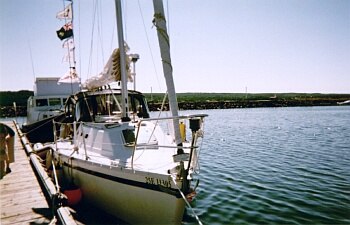
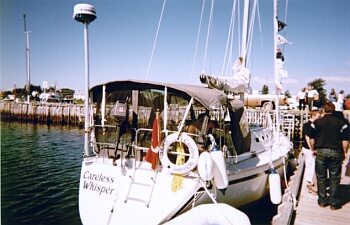
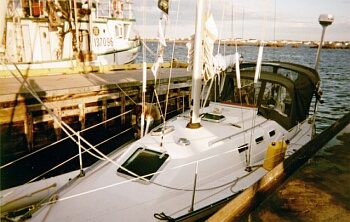
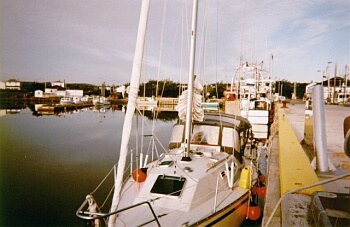
preparations to our new home. The boat itself is a 1984 Bayfield 32C
bearing hull #50. Bill had invested quite a lot in an already sound
boat to make the trip safer and more comfortable. She had radar,
windvane, autohelm, and amateur radio communication equipment on top of
all the standard electronics. Canned food enough for the entire voyage
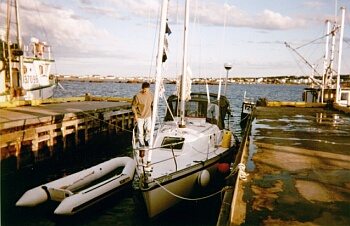
was stashed in various locations. Fuel containers and a deflated Zodiac
were lashed to the deck.
Salt Heart
certainly looked like a boat ready to go somewhere, as she sat a couple
inches lower in the water.
 |
| The view below |
On Monday morning, after saying goodbye to those who came by
the marina to bid us farewell, we cast off the lines and headed out the
harbour. Our intention was to go just as far as Wood Islands to get
everyone used to the boat, and each other. As we neared our
destination, things were going so well that we decided to carry on to
the Canso Lock, and find a place just beyond that to dock. While it
seemed like a good decision at the time, it was not long before the
wind and seas began to pick up. 2/3 of the crew got a bit sea sick
(names withheld!), the boat took some hard bangs, things were thrown
about the cabin, the gimbaled stove fell apart, we lost house batteries
and had to run the navigation lights using the starting battery, part
of a repaired trailboard broke off, the windvane had to be retired, and
for a few hours, the passage was generally miserable. Not quite the
leisurely sail we had expected.
About
0400 we arrived at the Canso Lock. I'd driven over the bridge and
causway several times, but this was my first time in the lock itself,
or any lock for that matter. It was interesting watching the large
steel structure swing out of our way. Once through, we passed two
fishing boats heading north - the wrong direction as far as we were
concerned. Bill went below to see where we were going to put in for a
few hours rest and recovery, while I played with the engine controls
and practiced maneuvering
Salt Heart
under power.
Port Hawkesbury was the closest town
which would likely have available most anything we required. We found
our way to an empty set of floating docks next to a large wharf. All
the local boats had been hauled out for the winter, and we were the
only vessel there - stranded behind a locked gate. It was good enough
for the night, or morning as it now was. It was close to 0600 by the
time we turned in, and almost lunchtime before we were up again.
After putting the wave tossed items away, we decided to move
Salt
Heart over to the wharf where the shore could be
accessed easier. Later in the day we moved her again, this time to the
other side where we would get some better protection from the expected
winds. John wisely saw that we were always pointing into any winds.
Most of the day was spent rewiring the boat so that we did not run into
problems like we had the previous evening. My suggestions were accepted
as part of the plan, and Bill and John went on an excursion to town to
purchase the parts we required. I stayed behind to continue the cleanup
operations. By dark we had everything up and running, better than it
was before.
The forecasted strong winds arrived on Wednesday, and we
decided it would be best to stay put for at least a day. It is just as
well we did since the fresh water electric pressure pump gave out, and
the used backup also failed to operate. Bill had a new pump stowed away
that got the water flowing again, but now we were without a backup. A
suitable replacement was found in Port Hawkesbury and delivered by
someone at the store. We had to remind Bill how warm he was going to be
once we got to the Bahamas to keep him motivated as he worked outside
in the cold, wind and rain.
While Bill was working on getting water into the boat, I was
forward trying to get water out of the boat. The head sink was not
draining. I traced the problem to a dip in the hose. I rigged up a
bracket to hold it closer to the underside of the v-berth, and we never
had that problem again. We needed both sinks working with 3 people
aboard.
At 1530 we checked in with
Herb
Hilgenberg (VE3LML,
Southbound II),
the expert marine forecaster from Burlington, ON, on 12.359MHz, USB. He
advised us to stay where we were for a couple days since the winds were
going to continue to be high. The crew of the tug,
Epinette
II, who were tied up next to us suggested the same
thing. They were not planning to leave until Saturday. They were also
kind enough to allow us to plug into their electrical. The wharf's
power connection did not mate with theirs, so they would have to run
their generator anyway. We only had a small heater and a light bulb to
power. The heat was certainly welcome. It was, after all, the middle of
November.
Thursday marked a week since I had left home. I had not packed
for so many days of cold weather, since I was only supposed to have a
couple days of it. Shorts remained buried deep in the duffel bag, while
t-shirts became another layer under the sweaters. Some clothes had been
worn 4 or more days since last washing. I needed to get a new laundry
bag to replace the one I borrowed from Bill. In addition, my big
flashlight had suffered massive internal injuries on the passage from
Charlottetown, so I was in need of another one. Bill and John had some
shopping to do as well, so we called a cab and headed into town to
clean out Canadian Tire and Sobeys. Bill got a voltmeter and an ammeter
to put on the house batteries to be able to keep an eye on their
health. The new wiring system had not, as yet, been given much testing
time, and we were planning to head offshore.
While Bill drilled more holes in the boat and installed the
gauges, John and I devised a way to mount the GPS to the binnacle with
parts we picked up during the shopping spree, and things we found on
Salt
Heart. A board across the handrail with 2 u-bolts
served to adequately secure the GPS stand where it could be used by the
helm, yet not block the compass, or take too much room away from hands
on the rail. I made a temporary connection into the compass light's
power. Bill fixed a minor electrical problem with the propane solenoid,
enabling John to cook up a wonderful steak dinner on the ungimbled 2
burner stove, even though the gimbaled unit was now functional again.
Before bed, we had to swing the boat around again to face into
the night's wind. I wasn't able to sleep feeling there was something
wrong with the boat, so I stuck my head out the companionway for a
look. The bowsprit was well over the concrete wharf, and the tide was
high. The dock lines would need adjusting before a lower tide level
caused the boat serious damage. While I was out working on this Bill
came up to see what was happening and gave me a hand. It didn't take
long to have her lying parallel again. I slept through the 0400 check
and fine tuning Bill did.
I always keep a road map with my navigation gear since many of
the charts I use don't have much, if any, detail on the communities. It
also gives you a good overview of an area. The old map I had stuffed
into my backpack was tattered, torn and missing a section, but it did
show that the
Town of Canso would be a good place
to head for. My thought was better many small steps than waiting for
one or two big steps. Bill and John were of the same mind, so at 1027
we finally left Port Hawkesbury behind.
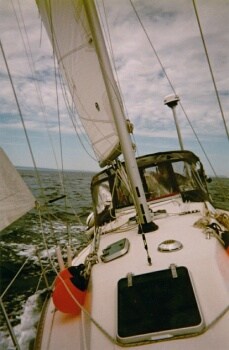
I had the wheel most of the passage and enjoyed a great sail
under double-reefed main and staysail in winds that gusted up to 30
knots. We had been motoring into the wind at first, but it was too much
strain on the engine. It overheated at nearly the halfway point, so
being a sailboat, we shut it off and kept going, at even greater speed.
6+ knots was not uncommon even though we were closehauled.
Along the way we passed close by a seal just bobbing in the
bay. We also passed very close to a fairway buoy. The skipper wanted to
be near enough to read the number, but I guess he didn't want to be
close enough to reach out and touch it. I hope it proved to him I could
handle the boat, and steer a good course. The buoy was our waypoint
after all.
The tug had left a couple hours prior to us, but we passed
them heading back into Port Hawkesbury before we were very far out.
Apparently, we rode the wind and seas much better than they did, and
thus arrived safely at Canso 1615, while they spent another day back
where they had been.
Entering
the harbour was not as difficult as it initially looked on the charts.
There were rocks and breakers, but the channel was well marked. There
was a floating section, not mentioned in the
Sailing
Directions, attached to the public wharf where power was
available, and so we docked there. We hadn't even finished tying up
when a woman from the port authority came looking for a fairly
reasonable $0.60 per foot. I think we would have paid more to keep the
heater running.
Problems this leg were limited to a blown fuse for the water
pump, and lose connection on the ham radio which caused us to miss our
check-in time with Herb. We could hear him talking to other boats on
the water not too far from us, so we managed to get some information
which was of use to us as well.
The sun was shining for the first time in weeks when we awoke,
and that inspired us to get busy with odds and ends still left to be
done on the boat. I rewired the power socket for the GPS more
permenently. A test showed that the twisted wire did not generate any
noticeable deviation. I then trimmed the edges of the board so that it
would be less likely to be in the way, and that also improved the
looks. Tape was put under the u-bolts, and the ends past the nuts cut
off. We were pleased with the result.
John and I then turned our attention to the rigging. I know I
should have checked before we got underway at Charlottetown, but here
we were at Canso without split rings, or even cotter pins, in most of
the turnbuckles. Looking up the mast track I could see it was more 'S'
than 'I'. We adjusted, checked tensions, stood back and looked,
readjusted, and eventually we had what we agreed was a well-tuned mast.
The town was lacking in supplies, so we pinned, ringed, or wired as we
could until the stay turnbuckles were all locked off.
By that time, Bill had completed installing the lights on the
new gauges, rewired the ham radio power, sent an email, returned from a
provisioning trip ashore, and had supper underway. The forecast looked
good for at least an 18 hour window. We'd check again in the morning to
verify it, and then get out as fast as we could. Bill used his
electronic charts to plot a route out of the rocky Canso harbour, and I
programmed the GPS with the waypoints. From that point on I was more
involved in the navigation and made regular GFIX's on the charts.
We got up a little earlier than we had been doing to eat and
get moving. We walked the boat down to the wharf and filled the tanks
with suspicious looking brown water we were told was good. By 0930 we
were heading out the harbour. Bill took us out so far, and then I
started my watch. Seas were still 2-3m, but winds were probably under
10 knots. Our friends in the tug passed us by shortly before we made
the turn onto the long track southwest towards Shelburne. Since we were
motorsailing anyway, we decided to hook up the autohelm, so I had
little to do during my 2000 to midnight watch. It was the only watch I
had were one of the self-steering machines was engaged for the entire
shift. I was not used to them. Being on watch, to me, had always meant
being at the wheel. This was a nice change.
I didn't sleep well because of the cold, so I got up around
0700 and fired up the new propane heater John and I suggested Bill pick
up at Port Hawkesbury. It helped a lot even though the wind was now
behind us and blowing down the companionway. The two kerosene lanterns
were unable to produce enough heat on their own. The third one was
leaking and was abandoned at Canso.
With all the hatches and port lights constantly closed to keep
the scant heat in, condensation was everywhere. While conditions were
as good as could be expected under the circumstances, they were far
from ideal. Water dripped on us from the hatches, and everything closed
off between the walls and the hull was damp. We had to open the sliders
while in port to let some air circulate back there. You could feel the
cold draft flow over you while laying in the berth.
We did not see very many other boats during the entire trip,
but Monday morning a navy ship passed in front of us, and an
accompanying helicopter flew close overhead to check us out. (My camera
was never close when I needed it.) Bill and I were surprised by how
small a target the ship was on the radar. Later that night, a fishing
boat circling around in the dark, as another boat headed offshore, and
red lights shone from the land confused us for a while until we were
able to sort out what was what.
My evening watch was a hard one with the following seas and
winds to contend with, no autopilot, and no one on deck to talk to. We
had been making good time for most of the day though, with 6 and 7
knots SOG on the GPS being maintained. We were actually running ahead
of schedule, so that should have been a hint of things to come. I was
glad when my time was up and looked forward to crawling into my berth.
First, however, Bill wanted me to dig out the Shelburne harbour charts,
so I fired up the kerosene lamps and started going through the rolls. I
eventually found them and determined a heading to steer once we arrived
at the only waypoint in the GPS. We were using the nav aids feature of
the
Magellan 320 to give us reference to
the land we could not see at some 25 miles to starboard. I was very
tired by the time I finally got under some covers and my head on a
pillow.
Around 0200 I was tossed out of my bed. Apparently it was a
little rougher out, but being sleepy I wasn't overly concerned, so went
about getting myself settled in again. Then I heard Bill call out. I
stuck my head up the companionway to see what the problem was and saw
that it had become much more nasty than it had seemed down below. I
informed John who was already starting to get up, and got myself into
my floater suit. We tethered ourselves to the cockpit pad eyes, and
discussed how we were going to handle the gale force winds which were
directly on our course line. The decision was to shorten sail to just a
double reefed main, and then go further offshore to ride it out until
daylight.
It was up to me to go forward and lash down the staysail. Not
an easy task in the winds and waves, but I managed to secure the sail
to the deck and make my way back to the cockpit without being swept
overboard. I was wet through, freezing cold and exhausted, so after
determing there was little else I could do above decks, I had to go
below to get some rest. I used the leecloth on the settee for the first
and only time. It held me securely in place, and allowed me to get
about 4 hours sleep while the other two surfed down 6-8m waves.
By the time I was back on deck we were once again making
progress towards
Shelburne. Shortly after 0900 a
group of some 15 or 20 porpoises put on a show for us as they passed
across the bow from starboard to port. Swells were still 2.5 to 4m, but
winds had dropped considerably. We arrived at the waypoint for the
entrance to Shelburne harbour about 1600, just as it was starting to
get dark. It took over 2 hours more before we found a wharf to tie to
and got settled in. Fortunately, there was power on the wharf for the
heater. We ate a quick supper and started getting ready for bed. I sat
down for a second to rest my eyes and was out. I woke up a couple hours
later and got into my sleeping bag - clothes and all.
Wednesday morning there was frost on the boat, and a light
skim of ice covering the salt water around the boat, but the sun was
shining. Bill and John hung a few things like floater suits and
sleeping bags around the deck to air out and dry. Bill then went for a
walk to see what services were available to us. I got a good wash in
the head, and then sorted my laundry. We spent most of the day washing
and drying our clothes at Murphy's. We picked up some groceries and
other items, like warm gloves. Keeping warm, especially the hands, was
a major problem for all of us. Various combinations and layers were
experimented with. We were getting close to finding the ideal solution.
Getting across the Gulf Stream quickly was the best one. Upon return to
the boat John prepared another marvelous meal. Being tucked down behind
a high wharf and even higher boats, we were unable to make contact with
Herb, so an important forecast was missed with us planning to head for
Bermuda the next day.
There were still lots of little jobs to do on Thursday before
we could go. An inspection of the boat showed that the top two sliders
were broken at the head of the main sail. Bill got two off the old
main, and John and I made the repairs. He and I were not too happy with
the way the lines were arranged on the boom, so we reconfigured the
reefing lines, outhaul and topping lift. I secured the fuel cans. We
then headed over to another wharf to flush and fill the water tanks and
containers. A sloppy deck filler cap that had allowed salt water to get
in the fresh water tank was sealed shut. (No wonder my tea tasted so
bad!) At shortly past 1530 we were on our way to Bermuda.
I took the helm as soon as we cleared the dock when Bill went
below to call
Southbound II. Out
clear of the wharf, and the other boats, he was able to get a signal
though. John started his watch at 1600. I stayed with him to finish
stowing the fenders and dock lines, then helped raise the main. That is
when we discovered a problem with the Spinlock. It wouldn't hold the
lines. I had to leave the main in the self-tailer of the winch, and
then tie off the reefing line on top of it. I fooled with it a bit
later on, and managed to get it to catch, but that was just the first
problem. Next, was the masthead tri-light. It wouldn't work when we
switched it on. Bill got up and fiddled around behind the fuse panel
until he got it operating again, then went back to try and get a nap.
With everything apparently under control, I went below to have
a bite to eat and a short rest before putting on my floater suit and
gear, to help out while I awaited my watch. This is when the most
serious incident took place. We were on a run, heading out the harbour.
Winds were light so I didn't bother to rig the gybe preventer I had
devised. John didn't like it anyway since it was difficult to operate
when single-handed. Next thing I knew there was a great noise from the
cockpit. Bill stuck his head up to see what the problem was and was
told that we had gybed, but the traveler stop didn't stop the car, and
was lost overboard. (
My theory: The stop was probably only
resting on top of a screw head, and not secure in a hole. The plastic
ends of the traveler must have been too cold and brittle to withstand
the sudden force. When the sail came across, there was nothing there
capable of holding it.) John was holding onto the loose main
sheet after having headed the boat into the wind, back towards
Shelburne. I went up to see what I could do.
The sheet was too tangled to get working with the boom
bouncing about, so I put the car back on the track and tied it off
against the remaining stop. Then I dropped the main and secured it to
the boom. It was at this time I learned that the lost stop was a new
one Bill had to get shipped in from Ronstan in Australia. It could take
weeks to obtain another one. There was a storm on the way we were
trying to keep ahead of when we set out, so even if we could get the
part faster, we'd lost our weather window, and would probably have to
wait another 4 or 5 days for the next one. It was quiet on the way back
as all hands considered the situation.
Once we were back in our old berth at the government wharf,
Bill announced that this was the end of it. He would haul the boat out
of the water in Shelburne and try it again next fall. We were all
disappointed, but agreed that this was probably the best decision. Too
much had happened, it was too cold, weather windows were small and
rare, and while the skipper had all winter, time was running out for
the two crew. It was 2 weeks now since I had left home.
We got up on Friday, and started getting the boat, and
ourselves, packed up. Bill went with a local resident, Rick, to see if
Salt
Heart could be stored locally, and if so, when they
could lift her out. I was just shaking the frost off the sails, and
getting ready to raise them to dry, when Bill returned saying we had to
go right away. The tide was dropping, and she had to come out before it
got too low. I returned to the marina facility with Rick to help catch
the lines. With all the stored boats and parked vehicles, the yard
workers had some trouble getting the travel lift over to the pen, and
the boat touched bottom twice before it was finally hoisted from the
water. All of our freshly added water was now part of Shelburne
harbour.
While the yard workers were busy blocking up the boat, Bill
went in search of a rental vehicle that could be used to carry all his
belongings, John's stuff, and the boat gear back to Charlottetown. John
and I made ourselves busy packing things. I barely managed to get all
my stuff back into the backpack and duffel bag they came over in. Most
items were cleared off the deck when Bill returned with news that a
truck would be ready at 1700. He too engaged in some packing, and also
made another unsuccessful attempt at contacting Herb to let hem know we
could be taken off his list. When the time came to go get the U-Haul,
Bill walked up to get it. Upon his return we threw what was ready in
the back, and went off in search of a motel room.
After checking in and depositing our belongings, we went out to a local
restaurant for our last meal together. We talked about the trip, and
what we were going to be doing when we returned home. We chatted about
things we never had time for while on the boat. The food was excellent,
as was the company. The three of us had lived together, in very close
quarters and imperfect conditions, for two weeks. It was sad to be
abandoning our effort, and breaking up the team. I could barely
remember what life was like in the real world.
Back at the motel I trimmed my now larger than normal beard,
showered, and generally prepared myself to be back in civilization.
Saturday morning Bill drove me up to the gas station where I'd catch
the first of 3 buses and a ferry to get me home. He and John still had
several hours of work to do, and a long drive back to Charlottetown. We
didn't quite get to the Bahamas, but we did have some good sailing,
good times, and learned many things. I also got to make two new
friends. I hope I'm available next fall should
Salt
Heart once again attempt the voyage south.
Top Ten Lessons Learned:
10. An unsecured object can become a dangerous
projectile when it gets rough, or at least make a mess of the cabin.
9. Things are going to happen, and you just have to
deal with them as best you can at the time. Survive now, improve later.
8. Keeping warm and dry can be a very difficult
thing to do, even with high tech materials. You can also have too many
layers.
7. Your best survival tool is a good sense of
humour, but you should be able to think fast on your feet too.
6. You can never be too prepared, but you'll never
have everything you'll need. Make sure you have all the basics covered.
5. A good meal does wonders for moral. Food is
important. Stick to meal schedules.
4. Don't leave port with serious problems, even if
you think you would handle it ok should the problem happen underway.
3. Surround yourself with good, capable people who
know what they are doing, and that can offer suggestions, but remember
that the person in charge has the final word.
2. Know when to quit. As Bill said, "He who fights
and runs away, lives to fight another day."
1. Keeping warm and dry in November on the North
Atlantic is tough!
- Peter Haliburton © 2000
The Official Ships Log of the Voyage
| Trip Log Summary |
| TIME |
LOCATION |
DISTANCE
(LEG/TRIP) |
SPEED
(LEG/TRIP) |
COMMENTS |
| Monday,
November 13, 2000 |
| 0930 |
Charlottetown, PE |
- |
- |
Departed for Wood Islands |
| Tuesday,
November 14, 2000 |
| 0530 |
Port Hawkesbury, NS |
92/92 |
4.7/4.7 |
Arrived |
| Friday,
November 17, 2000 |
| 1027 |
Port Hawkesbury, NS |
- |
- |
Departed |
| 1615 |
Canso, NS |
30/122 |
5.2/4.8 |
Arrived |
| Sunday,
November 19, 2000 |
| 0927 |
Canso, NS |
- |
- |
Departed |
| Tuesday,
November 21, 2000 |
| 1830 |
Shelburne, NS |
382/404 |
6.7/4.9 |
Arrived |
| Thursday,
November 23, 2000 |
| 1530 |
Shelburne, NS |
- |
- |
Departed for Bermuda |
| 1900 |
Shelburne, NS |
11/415 |
3.7/4.9 |
Returned to wharf |